News Archive
May 25, 2020 | APPLICATIONS FOR CARES ACT NON-COMPETITIVE AWARDS ACCEPTED THROUGH MID-JUNE AND COMPETITIVE AWARDS O
On May 7, the Economic Development Administration (EDA) began accepting applications for our CARES Act Recovery Assistance funding opportunities.
The $1.5 billion in Economic Adjustment Assistance funds made available to EDA to help communities prevent, prepare for, and respond to the coronavirus pandemic are authorized under the $2 trillion CARES Act signed into law by President Donald J. Trump on March 27.
Since releasing our CARES Act Recovery Assistance Notice of Funding Opportunity, EDA has invited more than 850 existing, high-performing Economic Development Districts (EDD), University Centers, Tribal Groups, and Revolving Loan Fund (RLF) grant recipients to apply for non-competitive supplemental funding to conduct assessments to fortify programs to assist communities in responding to the pandemic.
EDA is accepting non-competitive CARES Act Recovery Assistance funding opportunities applications that are submitted within 30 days of the date of the invitation letter. Submissions will be accepted through mid-June.
Simultaneously, EDA is also accepting competitive award applications from all eligible grantees for our CARES Act Recovery Assistance funding opportunities to help communities respond to and recover from the impacts of the pandemic.
For complete information, please visit our recently updated EDA CARES Act Recovery Assistance page.
(READ MORE)
May 21, 2020 | Georgia Film, TV COVID-19 Best Practices Available to Industry as Production Planning Continues
Atlanta, May 22, 2020 –Governor Brian P. Kemp today announced a filming “best practices” guide for Georgia that offers guidance for Georgia’s thriving film and television industries to help reduce the spread of COVID-19 when productions resume in Georgia. The recommendations were developed in close cooperation with officials from studio and production companies who maintain a presence in Georgia, and they can be found online at the Georgia Film Office’s website here.
As future film and production planning continues, these best practices are available to anyone considering filming in Georgia while prioritizing the safety of all cast and crew. Companies may opt to use these recommendations in conjunction with industry-wide labor and management protocols as they are developed.
“We are so grateful to the hardworking people who make up and contribute to Georgia’s incredibly successful film and TV industry, and we thank them for all the ways they have given back throughout the state’s response to COVID-19,” said Governor Kemp. “The Georgia Film Office has maintained their close work with industry executives to develop these outlines for how productions can help protect cast and crew members. These best practices are offered as an addition to any industry-wide labor and management recommendations for protocol.
“Every element of what has made Georgia such a unique place for film – landscapes, production facilities, a skilled and growing workforce, with a pipeline of new labor thanks to the Georgia Film Academy and our College and Career Academies – are still in place, just as they were before this global pandemic. Last year, Georgia set a new record for film, and we will continue to work with our partners in the industry to get Georgia back on the same track that made our state the successful production center that it has been for years.”
Prior to the worldwide COVID-19 response, which brought film and television production activity to a virtual standstill worldwide, Georgia set a new record for film during fiscal year 2019. The 391 film and television productions that filmed in Georgia spent $2.9 billion in the state, supported 3,040 motion picture and television industry businesses, and delivered $9.2 billion in total wages.
“Georgia’s partnership with our film and television production industry is stronger than ever. During this global pandemic, we have maintained an open dialogue with our partners to protect Georgians working in the industry, while collaborating on best practices to bring production back and safely restart the economy. We applaud our industry partners for the ways in which they have continued to give back and support the state’s efforts to combat COVID-19,” said Georgia Department of Economic Development Commissioner Pat Wilson.
“The backbone of Georgia’s film and television industry is made up of small businesses in every corner of our state, and these businesses have helped create the environment that makes Georgia such an attractive place for productions,” Wilson added. “We will continue to help these important businesses navigate new circumstances. As we return to production across the state, there is no doubt Georgia will maintain its position as a powerhouse for film and television production.”
Georgia’s film workforce has used their talents to provide critical help and find work during the pandemic. More than 51,000 Georgians work in film and TV production, and while film projects are on short-term hiatus, many crew workers have adapted their skills to assist front line efforts. The Georgia Film Office spotlighted a few of these efforts. Support resources and assistance for industry professionals and businesses remains available on the Georgia Film Office website here.
Regardless of industry, Kemp is urging all Georgians to get tested for COVID-19. For more information on active testing sites across Georgia and how to schedule an appointment, click here.
For additional information on the impact of Georgia film in fiscal year 2019, click here.
The “State of Georgia Film and Television Production Best Practices to Reduce Contagion of COVID-19” guide is available here.
Contact
Candice Broce, Director of Communications & Deputy Executive Counsel
Office of Governor Brian P. Kemp
candice.broce@georgia.gov
Cody Hall, Press Secretary
Office of Governor Brian P. Kemp
cody.hall@georgia.gov
RELATED CONTENT
July 24, 2020 Rural Georgia Businesses Protect Neighbors, Commit to Georgia Safety Promise
July 20, 2020 Film Productions Queuing Up in Georgia
July 13, 2020 Female-founded Amebous Labs to Open Virtual Reality Gaming Production Studio in Atlanta
June 30, 2020 Georgia Public Assembly Facilities COVID-19 Reopening Guide Now Available
(READ MORE)
May 17, 2020 | Over 220 Georgia Companies Providing Critical Supplies to Fight COVID-19
Atlanta, May 18, 2020 –Governor Brian P. Kemp today announced a list and interactive map of Georgia companies that have signed up to help businesses obtain personal protective equipment and health care supplies to fight COVID-19. The Georgia Suppliers Interactive Map and List, compiled by the Georgia Department of Economic Development (GDEcD), includes more than 220 Georgia companies providing needed protective supplies, along with an interactive map displaying business location and a tool to sort supplies by category.
“When we asked Georgia businesses to aid with needed supplies in our fight against COVID-19, they answered that call. I thank all of the hardworking Georgians and businesses who have made these supplies available,” said Governor Kemp. “We are all in this together, and this new resource will help Georgia companies source the supplies necessary for keeping their employees and customers safe, while remaining open for business.”
As the state continues to make progress in getting back to business, Georgia enterprises are encouraged to use this list and map as a free resource. Potential buyers are also reminded that they will need to do their own vetting of listed companies as they obtain needed supplies. Whether a restaurant, clothing boutique, manufacturing plant, or any of the many companies who get to call Georgia home, this unique resource will help businesses find supplies critical for keeping Georgians safe. At the same time, it will allow Georgia businesses to continue to support each other and keep valuable dollars in the state.
Serving as a liaison between the State of Georgia and the private sector, the GDEcD’s Centers of Innovation division compiled this list alongside countless Georgia companies that pulled together, retooled their machines, and worked to provide the most critical goods and services for fighting COVID-19. The list remains dynamic, and new businesses will be added periodically.
“Our strong relationships across the State of Georgia have proven vital in the fight against COVID-19,” said GDEcD Commissioner Pat Wilson. “Led by our Centers of Innovation, the Georgia Department of Economic Development has been proud to work across divisions to aid the state’s business community during COVID-19. Public-private partnerships continue to produce quality results, and I thank all of the companies who have stepped up to help their fellow Georgians by producing these critical supplies that will help keep us safe and get back to business.”
If your company can help with critical health care supplies and is interested in being included on the “Georgia Suppliers Interactive Map and List,” please complete this form.
Contact
Candice Broce, Director of Communications & Deputy Executive Counsel
Office of Governor Brian P. Kemp
candice.broce@georgia.gov
Cody Hall, Press Secretary
Office of Governor Brian P. Kemp
cody.hall@georgia.gov
(READ MORE)
April 22, 2020 | Federal Legislative Update - April 22, 2020: Special Edition
Legislation
Supplemental 3.5 – Interim Emergency Coronavirus Relief, formally titled “Paycheck Protection Program and Health Care Enhancement Act” (HR 266)
Timeline: After passage by voice vote in the Senate yesterday, the House will consider the bill (H.R. 266) tomorrow afternoon. Once passed by the House, the President is expected to sign the bill this week.
Process: The House will meet at 10:00 a.m. tomorrow and begin an extended voting series, voting first on the establishment of the Select Committee on the Coronavirus Crisis. Republicans may request a recorded vote on the Select Committee rule vote, which will add additional time. As members will be following protocols aimed at ensuring proper social distance, each vote will likely take an hour. After the vote on the Select Committee, there will be two hours of debate on the interim package and finally, a vote on final passage.
Policy: Text here. Section by section here. Summary of hospital and testing provisions here. Leader Schumer Dear Colleague on the bill here. See below for highlights from the bill. Notably, additional funding for state/local/tribal governments and SNAP/nutritional funding did not make it into the bill.
- $310 billion total for PPP with $250 billion unrestricted and a $60 billion set aside for smaller institutions:
- $30 billion for assets less than $10 billion;
- $30 billion for assets between $10 billion and $50 billion.
- $50 billion for EIDL loans;
- $10 billion for EIDL Advance grants;
- $2.1 billion for SBA administrative expenses.
- The bill also clarifies agriculture enterprises are eligible for PPP (they were eligible for 7(a) in the past, but they weren’t eligible for EIDL because they received disaster relief from USDA in the past).
- The bill did not expand PPP eligibility to 501(c)(6)s and 501(c)(7)s, but lawmakers have brought up the issue with Secretary Mnuchin, specifically regarding local and regional chambers of commerce. Treasury is currently looking into is whether they have enough regulatory authority to expand eligibility or if that requires a legislative fix.
- $75B for hospitals and providers (summary of hospital and testing provisions here);
- $25 billion for testing, broken into the following categories:< >$2 billion for states using the Public Health Emergency Preparedness grant formula;$4.5 billion provided to hotspot areas;$750 million for tribes, tribal organizations, and urban Indian health organizations in coordination with IHS.(Note: This bill will roughly double the amount that Congress has appropriated for NIH for COVID-19 purposes so far.)$11 billion for states, localities, territories, and tribes to develop, purchase, administer, process, and analyze COVID-19 tests, scale-up laboratory capacity, trace contracts, and support employer testing.
- $1 billion for the CDC for surveillance, epidemiology, laboratory capacity, contact tracing, public health data, and analytics infrastructure modernization;
- $1.8 billion to NIH for testing and associated technologies and for partnerships to research and implement the activities;
- $ 1 billion for BARDA for advanced research, development, manufacturing, production and purchase of COVID-19 tests and related supplies;
- $22 million for the FDA for diagnostic activities;
- $825 million for Community Health Centers and rural health clinics;
- $1 billion to cover costs of testing for the uninsured;
- $6 million for the HHS Office of Inspector General.
Supplemental IV – CARES 2.0. / Phase 4
Timeline: Once passage on CARES 3.5 is complete and Congress takes a (brief) breather, attention will turn to the next spending bill, termed “CARES 2.0” by some and “COVID 4” by others. The House is still scheduled to return on May 4, but likely won’t be ready for a vote until mid- or late-May.
Process: House committees have already begun work on the bill. Democrats want it quickly; Republicans want to slow down and see how the spending so far has been used. There is a sense that Republicans are beginning to have “spending fatigue”.
Policy: This will likely be a large bill, at least $1 trillion. It’s unclear exactly what might be included in Phase 4. Some indicators point to an increasingly health-centered bill, with additional funding for state, local, and tribal governments, SNAP/nutritional funding, and additional unemployment support. Others seem to point to a bill that simply pluses up the programs funded in CARES. Some Republican members have pointed to a more economic stimulus and recovery-focused bill, with funding for infrastructure like broadband, roads, and bridges. Republicans have also voiced concern around energy industry losses and its implication for the broader economy.
Passed Legislation
Supplemental III – Coronavirus Aid, Relief, and Economic Security (CARES) Act
After a unanimous vote by the Senate, the House passed the bill on March 27 and the President signed the bill into law shortly after. Final text here. Democratic summary here. Republican section by section here.
New information and guidance:
- 4/20 – SBA/WH data on Economic Injury Disaster Loans here, EIDL Advance here.
- 4/22 – CARES Act Provider Relief Fund overview here.
- 4/22 – Treasury issued guidance on the state/local/tribal governments fund here, and an FAQ here
Summary of Funding Available for Hospitals/Providers
Total funds available: $175 billion ($100 billion CARES + $75 billion COVID 3.5)
- $30 billion has already been distributed.
- $10 billion for current hotspots area – Top 100 counties based on COVID cases. Distributed today at 2:30 p.m.
- $10 billion for future hotspots. Distributed in 45 days
- $10 billion for rural healthcare. TBD
- $400 million Native American healthcare. Distributed April 24
- $20 billion to “reconcile” initial fund distribution
- $9.3 billion for heavy Medicare / Medicaid providers, children hospitals, and other providers. Distributed April 24
- $10.7 billion for providers with extreme loss through a provider certification form. TBD
- $10 billion for the uninsured. Established next 10 days for application portal and 30 days for reimbursement
- Balance: $85 billion. HHS is developing a plan to distribute these funds.
Title I – Small Business Loans
- 4/3 – The Treasury Department released affiliation guidelines for the small business loan program.
- The Treasury Department released an interim final rule on the small business provisions in the bill. See here for a memo Cornerstone put together on the interim final rule. See here for a report from SBA on approvals through 4/13. .
- 4/16 – Treasury and the SBA announced that the Paycheck Protection Program ran out of funding. Press release here.
- Note: “By law, the SBA will not be able to issue new loan approvals once the programs experience a lapse in appropriations.”
- Treasury FAQs on the Paycheck Protection Program
- Top-line overview of the program here
- Lender information here, Borrower information here, borrower application here
- Updated (as of 4/17) FAQ here
- Clarification regarding loan forgiveness: the forgiveness period triggers on day of loan closing. Forgiveness on the loan is available for the 8 weeks after the loan closes. Businesses can use the funds to pay payroll prior to that 8 week period, but it won’t qualify for forgiveness
- 4/20 – SBA/WH data on Economic Injury Disaster Loans here, EIDL Advance here
Title II – Individual and Business Tax Relief
- IRS guidance on deferral of payroll taxes here
- House Ways and Means factsheet on Economic Impact Rebate portal here
- IRS has indicated that the earliest Americans could receive relief payments from CARES was the week of April 13th. Those who will receive their relief through paper checks could take as long at 20 weeks to receive payment.
- IRS’s FAQ page on individual economic relief here.
- Treasury Guidance on Employee Retention Tax Credit here
- Treasury FAQ on Employee Retention Tax Credit here
Title III – Public Health Systems, Education, and Healthcare
- 4/10 – HHS issued guidance, announcing the formula and mechanism in which hospitals will receive the first $30 billion in relief funding. The money does not have to be repaid and can be used for a variety of uses. The first tranche went to hospitals based on their Medicare FFS reimbursements in 2019. As total FFS payments were approx. $484 billion in 2019, a provider can estimate their payment by dividing their 2019 Medicare FFS (not including Medicare Advantage) payments they received by 484 and multiply that ratio by 30. If the providers total 2019 Medicare FFS payments were Y, then (Y ÷ 484) x 30 = amount of relief. State by state breakdown of first payment here.
- HHS is working on developing a plan for how to disburse another $30 billion for Medicaid-heavy providers and potentially a focus on pumping money to providers in hotspots.
- Factsheet on accelerated and advance payments for providers/suppliers here
- 4/9 – Secretary DeVos indicated that she would be moving to "immediately distribute" the $6 billion in CARES for emergency financial aid grants to college students. The grants can be used by college students for technology, course materials, food, housing, and healthcare. DeVos distributed the funding to colleges, which are meant to then distribute the aid among students. The Department did not issue guidance on how colleges are to structure the program, but colleges will be required to sign a form certifying that the funds were used in accordance with the law. See here for the specific allocations for each college.
Title IV – Economic Stabilization
- 3/30 – The Treasury Department released guidance on payroll support to airline industry employees, and on loans to the airline industry and businesses critical to national security. Guidance for payroll support here. Guidance on procedures and minimum requirements for loans here. Treasury press release here.
- 4/10 – Treasury Q&A on Loans to Air Carriers and Eligible Businesses and National Security Businesses here. Loan application here.
Division B – Appropriations
- 4/8 –The FCC announced a two-part, $200 million COVID-19 telehealth program. The press release may be found here; and the FCC order approved on Wednesday (4/8) can be found here.
- 4/13 – Treasury launched its web portal for payments to state, local, and tribal governments. Treasury announced that eligible government entities must provide required information by Friday, April 17 to receive payment within the 30-day window allowed under CARES and those that miss that deadline may not receive funding. Submission page here. Some highlights from the announcement below:< >Are necessary expenses during the coronavirus emergency;Were not accounted in the most recent budget (as of March 27, 2020);Were incurred between 3/1/2020 – 12/30/2020.Funds are only allowed to be used for expenses which:
- Eligible local governments are those below the state level (county, municipality etc.) with a population higher than 500,000. See here for data sources and the distribution methodology. See here for a list of eligible local government units.
- Amounts paid to governments will be based on population and the amounts allocated to states will be reduced by the total amount provided to local governments in the state.
- Payments to Tribal Governments will be determined by the Treasury Secretary in consultation with the Interior Secretary and Tribes. Consultation has not yet been completed.
- 4/22 – Treasury issued guidance on the state/local/tribal governments fund here
- The guidance further defines what expenses qualify as “necessary expenditures” and provides examples as well as examples of ineligible expenses.
Cornerstone resources on certain areas of the bill:
- Memo for health care providers here
- Memo on the Small Business Administration loan programs here
- Memo outlining the workers and families assistance programs here
- Memo outlining technology opportunities here
- Memo outlining FEMA opportunities here
- Memo on the bill’s higher education provisions here
- Memo for non-profits here
- Memo on CARES Act and Airports here
- Memo on the status of business operations in Mexico here
Supplemental II – Families First Coronavirus Response Act (HR 6201)
The Senate passed the House bill on March 18 and the President signed the bill into law that evening. Bill text here. Factsheet here. Bill section by section here. A summary of paid leave provisions, incorporating changes made by technical correction, is here.
Supplemental I – Coronavirus Supplemental
Signed by the President March 6. Text here, summary here.
Congress
Session: The House has announced that it will not reconvene before May 4. D.C. is currently under a stay-at-home order, and Maryland and Virginia have similar orders in place. In a Dear Colleague last week, Speaker Pelosi advised members to keep their schedule flexible and said that, in order to make up for lost time, the House may meet during weeks previously scheduled as District Work Periods. The Senate is in recess until April 20.
Appropriations/NDAA: Subcommittee markups have officially been postponed. While timing continues to be unclear, House Appropriations Committee (HAC) will likely stick to the original subcommittee order of markups, just shifting everything back by 2-3 weeks. The House may try to hold markups soon after the next package is passed, when all members have returned D.C. The Senate Appropriations Committee (SAC) has floated two different allocations to subcommittee clerks, the differentiating factor between the two allocations being how VA Choice is treated. SAC has given subcommittees direction to stick with the original plan of marking up all of the bills in June.
This year’s NDAA markup has been “indefinitely postponed”. Reps. Adam Smith and Thornberry (HASC Chair and RM) sent a letter to the committee members saying that they will schedule the date of the markup once the House schedule for the next few months becomes clear. SASC Chairman Inhofe has said he aims to writing the FY21 NDAA by the end of May but is flexible considering the circumstances.
Remote voting: After pushback from Republican House members, Speaker Pelosi pulled the proxy voting proposal from the agenda tomorrow, instead tasking a bipartisan group to review proposals for proxy voting and procedures to reopen the House. The group includes Majority Leader Hoyer, Minority Leader McCarthy, Chairman McGovern (Rules), Ranking Member Cole (Rules), Chairwoman Lofgren (House Admin), and Ranking Member Davis (House Admin). The resolution proposed by Chairman McGovern here and includes protocols for proxy floor voting, and remote committee hearings and markups. Rules Majority proxy voting FAQ here. Leader McConnell, as of right now, is not supportive of any form of remote voting.
Other Floor Action: The House has issued guidance indicated that Floor materials are to be submitted through a secure email address instead of dropped off at the Speaker’s Lobby or Cloakrooms. Members are still allowed to drop off materials in person. Speaker’s Dear Colleague on the guidance here.
Hearings and Meetings: While most hearings and markups have been cancelled, some committee staff are working to see whether holding hearings virtually is possible. The Senate Rules Committee Democrats released a one-pager guidance on “paper hearings”, which stated “paper hearings” are not official hearings. The Senate Sergeant at Arms is exploring technology that would allow for remote hearings, though Leader McConnell remains opposed to any form of remote voting. Under current rules, the House does not allow virtual hearings. Chairman McGovern’s proxy voting proposal would also allow remote hearings and markups. The House Administration Committee is working on a report on best tools to be able to do virtual meetings. The Senate has advised offices to avoid using the video conferencing app Zoom over data security concerns. The Senate has not yet officially banned the application though.
Members of Congress in Quarantine or Treatment (new additions in bold)
Tested Positive (1): Rep. Neal Dunn (R-FL)
Currently Self-Quarantined (0):
Recovered (6): Sen. Rand Paul (R-KY), Rep. Joe Cunningham (D-SC), Rep. Ben McAdams (D-UT), Rep. Mario Diaz-Balart (R-FL), Rep. Mike Kelly (R-PA), Rep. Nydia Velazquez (D-NY)
Completed Quarantine (37): Sen. Ted Cruz (R-TX), Rep. Mark Meadows (R-NC), Sen. Lindsay Graham (R-SC), Rep. Don Beyer (D-VA), Rep. Sharice Davids (D-KS), Rep. Doug Collins (R-GA), Rep. Paul Gosar (R-AZ), Sen. Cory Gardner (R-CO), Sen. Rick Scott (R-FL), Rep. Matt Gaetz (R-FL), Rep. Jason Crow (D-CO), Rep. Julia Brownley (D-CA), Rep. Ben Ray Luján (D-NM), Rep. Gwen Moore (D-WI), Rep. Stephanie Murphy (D-FL), Rep. John Yarmuth (D-KY), Rep. Adam Schiff (D-CA), Rep. Vincente Gonzalez (D-TX), Rep. Drew Ferguson (R-GA), Rep. David Schweikert (R-AZ), Rep. Anthony Brindisi (D-NY), Rep. David Price (D-NC), Rep. Ann Wagner (R-MO), Rep. Kathleen Rice (D-NY), Rep. Matt Cartwright (D-PA), Rep. Tom Cole (R-OK), Rep. Steve Scalise (R-LA), Rep. Frederica Wilson (D-FL), Rep. Andy Kim (D-NJ), Rep. Kendra Horn (D-OK), Sen. Mike Lee (R-UT), Sen. Mitt Romney (R-UT), Rep. Katie Porter (D-CA), Rep. Seth Moulton (D-MA), Rep. Lizzie Fletcher (D-TX), Rep. Josh Gottheimer (D-NJ), Rep. Ayanna Pressley (D-MA), Rep. Mikie Sherrill (D-NJ)
COVID-19 Compilation: 4.22.20
Washington, D.C.
- President Trump signed an executive order mandating a 60-day halt in issuing green cards to prevent people from immigrating to the U.S.
- CMS and ASPR released a new toolkit to help state and local healthcare decision makers maximize workforce flexibilities when confronting 2019 Novel Coronavirus (COVID-19) in their communities. This toolkit includes a full suite of available resources to maximize responsiveness based on state and local needs, building on President Trump’s commitment to a COVID-19 response that is locally executed, state managed, and federally supported.
- The CDC and USDA confirmed the first cases of COVID-19 in two pet cats. They are the first domestic pets to test positive in the U.S.
- HHS and HRSA announced that they awarded nearly $165 million to 14 Telehealth Resource Centers (TRCs) to help rural and underserved areas combat COVID-19. TRCs will be able to use the funds to provide hands-on technical support in areas such as equipment acquisition, payment policy, system design, and licensing and credentialing. The awards can be found here.
- HHS is asking hospitals for information that it will use to allocate targeted payments from the COVID-19 provider relief fund. Hospitals must submit this requested information by Thursday night:
- total number of intensive care beds as of April 10th
- total number of admissions of patients with a positive COVID-19 diagnosis from January 1st to April 10th
- national provider identifier
- The Treasury Department released an FAQ sheet about the state and local section of the Coronavirus Relief Fund.
- Agriculture Sec. Sonny Perdue announced emergency benefit increases for SNAP households in the U.S. USDA is providing a 40 percent increase in SNAP benefits to help families who have been hit with economic distress due to COVID-19.
- More than 50 education and related national associations sent a letter to House leadership urging them to include Rep. Grace Meng’s (D-NY) recently introduced bill, H.R. 6563 (116) in the fourth coronavirus relief package. The bill would create a special $2 billion Emergency Connectivity Fund administered through the FCC’s E-rate Program for schools and libraries to support remote learning. The funds would be used to purchase Wi-Fi hot spots, modems, routers, and internet-connected devices.
- On April 29th from 12:15 pm - 1:15 pm ET, the FDA will host a virtual Town Hall for clinical laboratories and commercial manufacturers that are developing or have developed diagnostic tests for SARS-CoV-2. The purpose of this Town Hall is to help answer technical questions about the development and validation of tests for SARS-CoV-2.
- Per guidance issued yesterday, the Education Department will prohibit colleges from granting emergency assistance to undocumented students, even those currently under federal protection. The Department claims the CARES Act makes clear the relief fund should be used for U.S. citizens.
- Tomorrow, the IRS will hold an Economic Impact Payment (EIP) discussion (with live Q&A) with the American public at 2pm ET. Pre-registration is required.
- The Senate passed more than $480 billion in interim emergency relief yesterday. The legislation includes $310 billion to replenish the SBA Paycheck Protection Program, $60 billion for separate disaster loans to small businesses ($50 billion for the Economic Injury Disaster Loan program and $10 billion for the Emergency Economic Injury Grant program), $75 billion in emergency funds for hospitals, and $25 billion for testing. The House is set to vote on the measure tomorrow afternoon. riencing homelessness and pregnant people, strategies to optimize the supply of PPE, and information about pregnancy and breastfeeding.
- DHS published notifications of two temporary travel restrictions: the extension of restriction between the U.S. and Mexico and the U.S. and Canada.
- Dr. Rick Bright issued a statement about his removal from his post at BARDA. More background is available here.
- No new members of Congress have tested positive for COVID-19.
Updates from the States
- Out of the cases under investigation detected by U.S. surveillance, there are total cases: 802,583 and 44,575 deaths The CDC data closes out the day before reporting.
- The number of deaths due to COVID-19 may increase as autopsies in California are showing people may have been infected with the virus in the U.S. as early as the beginning of February. Dr. Sara Cody, the chief health officer of Santa Clara County, south of San Francisco, said the newly diagnosed cases underlined that the virus was spreading undetected for weeks in the country in January and February.
- President Trump has indicated that he believes it is too soon for gyms, hair salons, and tattoo parlors to reopen on Friday in Georgia.
- South Dakota, Iowa, and North Dakota remain the only states without a stay-at-home order. South Dakota also does not have enforceable restrictions against large gatherings. The state has recorded 1,755 cases of the virus and eight COVID-19-related deaths.
- Reopening Updates:
- California Gov. Gavin Newsome (D) announced that hospitals will now start to schedule essential surgeries, in coordination with Washington and Oregon, effective immediately.
- Colorado Gov. Jared Polis (D) announced that Colorado’s stay-at-home mandate is being updated to a ‘safer-at-home’ mandate, with certain businesses reopening this Friday.
- Kansas Gov. Laura Kelly (D) announced relaxed medical licensing restrictions to help meet the demands of the state’s healthcare needs.
- Maryland Gov. Larry Hogan (R) announced that he will unveil plans to reopen the state on Friday.
- Michigan Gov. Gretchen Whitmer (D) said she will likely extend her stay-at-home order beyond April 30th even if she reopen parts of the state’s economy.
- Montana Gov. Steve Bullock (D) announced the state’s stay-at-home order would be lifted effective April 26th.
- Useful state data:
- These charts show cumulative coronavirus cases and deaths for metropolitan areas over time.
- Use Johns Hopkins University’s COVID-19 U.S. map as a resource for media, policymakers and communities to view a collection of critical public health data in one online destination and better understand and track the COVID-19 pandemic in populations both large and small across the country.
- NASHP has developed a COVID-19 State Action Center which serves as a state-level policy dashboard.
- This site from the Kaiser Family Foundation provides state-level information on cases/deaths, social distancing measures, health policy actions, and more.
- This resource from Bloomberg Law is a database of State Quarantine and Public Health Laws related to the COVID-19 response.
- This series of maps shows how states are responding to COVID-19, and this tracker, created and maintained by MultiState Associates, has an up-to-date list of executive orders and various travel restrictions.
- Finally, this site offers COVID-19 projections assuming full social distancing and can be broken down by state.
Military/Defense
- The DoD announced a tiered COVID-19 testing plan with a goal of testing 60,000 service members a day by June. Tier one includes critical national capabilities, tier two includes deployed forces, tier three includes forward-deployed or redeploying forces, and tier four is the remainder of the force.
- The Army is testing all new recruits arriving at the service’s four initial training centers for COVID-19. New recruits began arriving yesterday after a two-week hold on new arrivals gave the Training & Doctrine Command time to prepare testing kits and social distancing measures.
- The Army Corps of Engineers (USACE) has begun construction on 32 facilities housing a total of 15,800 beds for COVID-19 patients. USACE has also designed 52 more facilities for states to build that will house a total of 17,260 beds.
- The Marine Corps has cut the number of recruits shipping to boot camp in half while also asking recruits to self-isolate for 14 days before arrival.
- President Trump will serve as the commencement speaker at West Point’s Class of 2020 graduation ceremony. Cadets were sent home during spring break due to the COVID-19 pandemic, but West Point officials are planning how to bring the soon-to-be-graduates back for the ceremony.
International Affairs
- WHO has launched a new online course on Standard precautions: Hand hygiene. The module has been prepared to help summarize the WHO guidelines on hand hygiene, associated tools and ideas for effective implementation. To date, there has been more than 1.5 million enrolments in the platform's courses to support the COVID-19 response.
- All of Germany’s states have now made it mandatory to wear masks, however the rules about where masks will be required varies by state. For example, it will not be mandatory to wear a mask in Berlin while shopping.
- Also in Germany, a biotech company said today that a COVID-19 vaccine candidate it had developed with Pfizer has been approved for clinical testing in Germany. It would be what is believed to be the fourth trial to get underway internationally in the race for a vaccine.
- India has seen a drastic clearing of pollution since implementing a lockdown. The deadliest particle in Delhi's air is particulate matter (PM) 2.5, which increases the likelihood of respiratory and cardiovascular diseases. PM 2.5 come from combustion like fires, cars, and power plants. One research group found that the levels of PM 2.5 in Delhi during the lockdown plummeted to 20 micrograms per cubic meter with a 20-day average of 35. To put this into context, between 2017 and 2019, the monthly average of PM 2.5 in the capital was up to four times higher.
- Amazonas has been among the hardest-hit states in Brazil with over 2,270 confirmed cases and nearly 200 deaths. Elsewhere in Brazil, officials in Manaus have had to create a mass grave at the edge of a cemetery. The mayor of Manaus said, “The health care system no longer has the capacity to provide care to the patients that need it and people are starting to die at home.”
- Haitian government officials are admitting they are unprepared to deal with COVID-19. The country has only 60 ventilators for 11 million people. The government has recently attempted to buy much-needed equipment (including tens of thousands of masks from Cuba) but health officials say it’s too little, too late.
- Officials in Taiwan are looking to turn their success in battling COVID-19 into a geopolitical win, sending millions of masks marked with “made in Taiwan” to countries hit hard by the crisis and launching a diplomatic and public relations campaign. The island is promoting itself as a model of democracy to try to undercut China’s own campaign to use the crisis to tout the strength of its authoritarian system, though Beijing has waved off the effort as an attempt to “seek independence under the pretext of the pandemic.”
- Eight infants and toddlers at a care center in Tokyo have tested positive for COVID-19, raising concerns about a wider outbreak at care facilities in the country for neglected or abused children.
- Global Cases: 2,471,136 Total Deaths: 169,006
Lifestyle and Economy
- The WTI rebounded and gained 20 percent after a devastating last two days.
- The S&P 500 is also up today, climbing by more than 2 percent. Chipotle Mexican Grill came out on top today with an S&P gain of 14 percent, which really feels like a win for me as well because I love Chipotle.
- Facebook founder Mark Zuckerberg published a piece about “How Data Can Aid the Fight Against COVID-19.”
- New York’s Metropolitan Transportation Authority (MTA) approved a benefits program for workers who die from COVID-19-related causes as the death toll among its workforce rose to 83. MTA officials have faced criticism from some workers who say the authority was slow to respond to the crisis. In particular, they are angry that some workers either weren’t allowed to wear face masks or weren’t provided with them during the first weeks of March. The benefit pays $500,000 to a spouse or beneficiary of a worker who dies because of the new coronavirus. It also provides three further years of health coverage for the person’s spouse and dependents.
- Multiple large Universities, including Stanford and Princeton, have said they will not accept the funds allocated to them under the COVID-19 stimulus package. Harvard was set to receive nearly $9 million, but said the government should allocate it elsewhere after they faced extended criticism from the academic and small business sectors.
- Two Tennessee brothers who stockpiled 17,700 bottles of hand sanitizer have avoided prosecution and a fine, but they will not recoup the thousands of dollars they spent on the supplies under the terms of a price-gouging settlement that the state attorney general announced this week. The brothers, Matt Colvin and Noah Colvin, donated the supplies last month to people in Tennessee and Kentucky, which the authorities said on Tuesday was acceptable as restitution and was a factor in the settlement terms in the highly publicized case.
- The New York Times is tracking media layoffs.
- Americans can track the status of their stimulus payments and provide their bank-account information to get their money faster via direct deposit on a new IRS website.
- Forbes is keeping a running list of all major international airline COVID-19-related change and cancellation policies.
- The New York Times has started its own tracker of cases in the U.S. to fill in the gaps left by agency data.
- Lists of canceled conferences and events can be found here (music), here (tech), here (general), and here (sports/entertainment).
Helpful Articles/Media
- Daily WHO Situation Report (4/22)
- Examining the social impact of COVID-19
- The Implications of COVID-19 for Mental Health and Substance Use
- COVID-19 exacerbating inequalities in the US
- COVID-19 in the USA: a question of time
- COVID-19 Outbreak Associated with Air Conditioning in Restaurant, Guangzhou, China, 2020
- The characteristics of household transmission of COVID-19
- The SARS-CoV-2 receptor-binding domain elicits a potent neutralizing response without antibody-dependent enhancement
- Symptom Screening at Illness Onset of Health Care Personnel With SARS-CoV-2 Infection in King County, Washington
- Here is this week’s COVIDView from CDC, a weekly summary and interpretation of key indicators that have been adapted to track the COVID-19 pandemic in the U.S.
- Finding Effective Treatments for COVID-19: Scientific Integrity and Public Confidence in a Time of Crisis
- Covid-19 is rapidly becoming America’s leading cause of death
- Antibiotic treatment for COVID-19 complications could fuel resistant bacteria
- Rapid coronavirus test, commonly used in U.S., may miss infections in some situations
- Food And Beverage Companies Evolve, Innovate And Contribute Amid COVID-19 Crisis
- Visualizing Speech-Generated Oral Fluid Droplets with Laser Light Scattering
- Coronavirus Vaccine Prospects
- The NIH Office of Portfolio Analysis (OPA) has developed a comprehensive, expert-curated portfolio of COVID-19 publications and preprints. The portfolio includes peer-reviewed articles from PubMed and preprints from medRxiv, bioRxiv, ChemRxiv, and arXiv. It is updated daily with the latest available data and enables users to explore and analyze the rapidly growing set of advances in COVID-19 research.
- ‘We need an army’: Hiring of coronavirus trackers seen as key to curbing disease spread
- Suicide Mortality and Coronavirus Disease 2019—A Perfect Storm?
- FEMA’s How to Help website.
- Safety at the Time of the COVID-19 Pandemic: How to Keep our Oncology Patients and Healthcare Workers Safe
- The effective use of telemedicine to save lives and maintain structure in a health care system
- Projecting hospital utilization during the COVID-19 outbreaks in the U.S.
- Johns Hopkins data capture.
- Other tracking data here.
Common Acronyms
Centers for Disease Control and Prevention (CDC), World Health Organization (WHO), National Institutes of Health (NIH), Personal Protective Equipment (PPE), Department of Health and Human Services (HHS), Department of Defense (DoD), Department of Homeland Security (DHS), U.S. Department of Agriculture (USDA), Central Command (CENTCOM), Department of Housing and Urban Development (HUD), Centers for Medicare and Medicaid Services (CMS), Transportation Security Administration (TSA), Department of Veterans Affairs (VA), Assistant Secretary for Preparedness and Response (ASPR), Biomedical Advanced Research and Development Authority (BARDA), U.S. Trade Representative (USTR)
Statistics

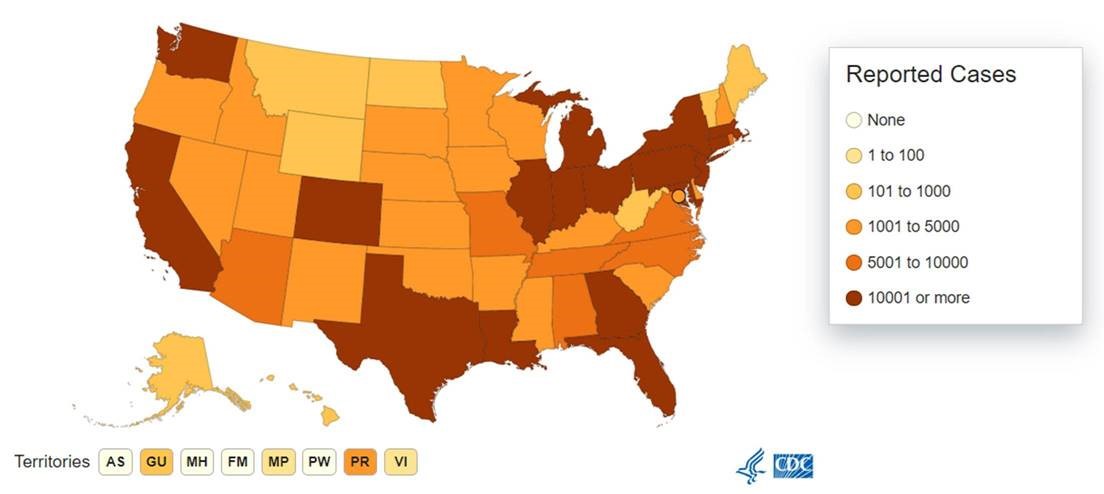
Map updated 4.21.20
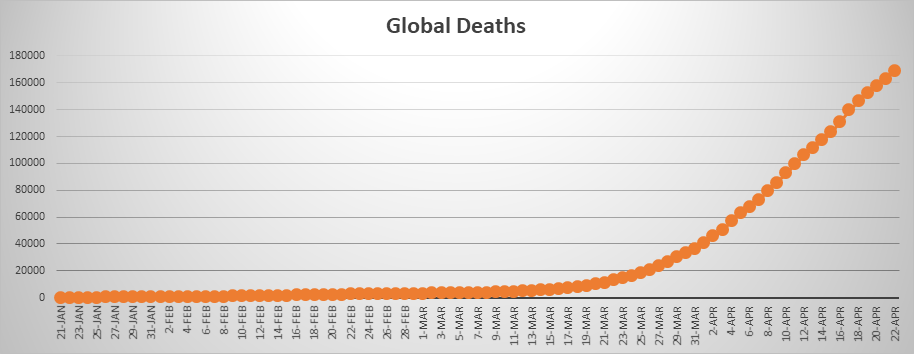
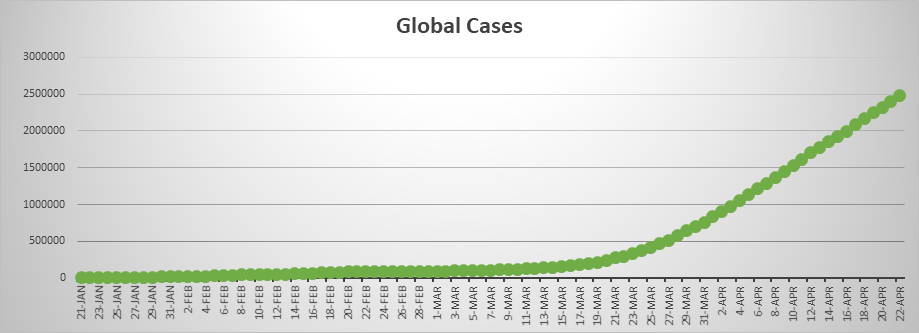
(data from WHO daily situation reports)
For more information, visit CDC’s Novel Coronavirus 2019 website
(READ MORE)
April 15, 2020 | Senator David Perdue To Serve On President’s Economic Task Force

Senator David Perdue To Serve On President’s Economic Task Force
Focused On Helping Get Americans Back To Work
ATLANTA, GA – U.S. Senator David Perdue (R-GA), a former Fortune 500 CEO, today was selected as a member of President Trump’s Congressional Economic Task Force. The Senator joins a number of bipartisan, bicameral congressional leaders who will provide direct counsel to President Trump on the re-opening of America in the wake of the COVID-19 crisis.
“President Trump’s agenda created the greatest economic turnaround in U.S. history. However, the COVID-19 crisis and the resulting shutdown of much of our country has taken a serious toll on our economy. Many Americans are not only worried about their health, but also whether they can keep their jobs, run their businesses, and provide for their families,” said Senator Perdue. “Even while we are still fighting this virus, we need to begin thinking about how to reopen our economy. Going forward, our objective should be to find a balance between keeping people healthy while protecting jobs and the economy long-term. While still focused on protecting human life in this crisis, President Trump worked with Congress to enact and sign into law the CARES Act to provide a bridge for businesses to keep people employed. As a former business CEO, I’m humbled to be named to the Task Force and look forward to helping get us all back to work.”
Senator Perdue is a political outsider who was involved in successful turnarounds of major American companies during his business career. Senator Perdue has been an advisor to President Trump and the White House in crafting and implementing policies that led to the U.S. economic turnaround prior to COVID-19.
As we purpose to reopen our economy, Senator Perdue will work to find a balance between fighting the virus and getting our economy going again.
###
When Senator Perdue was elected, he was the only Fortune 500 CEO in Congress. He is serving his first term in the United States Senate, where he represents Georgia on the Armed Services, Banking, Budget, and Foreign Relations Committees.
(READ MORE)
March 29, 2020 | Federal Legislative Update 2020: Special Edition
Here are Thursday’s COVID-19 headlines and helpful tidbits. Washington, D.C. - FEMA has a “How to Help” website for COVID-19 which includes donations, volunteering, and private sector subcategories.
- The EPA is relaxing enforcement of multiple environmental regulations because of worker shortages and travel restrictions caused by COVID-19, per a memo circulated today. This has caused a stir in the environmental activism community as many facilities benefiting from the relaxed standards are still operating under full capacity.
- President Trump sent a letter to America’s governors today saying the federal government hoped to provide a risk assessment for individual counties in conjunction with increased testing capabilities. In the letter, the President says that counties will be classified as high, medium or low risk to help local policymakers make decisions about whether to maintain, increase, or relax social distancing standards.
- NIAID’s Dr. Tony Fauci said today the Phase I vaccine trials have begun and that he hopes larger Phase II or Phase III trials can begin by the middle of summer.
- HHS banned the hoarding or price-gouging of N95 respirator masks, ventilators, gloves, and other personal protective equipment. The hoarding ban includes hydroxychloroquine after reports of the drug selling out at pharmacies. The list of banned materials can be found here.
- The House Committee on Homeland Security compiled this resource guide for DHS’s response to COVID-19.
- Sen. Rand Paul (R-KY) and Reps. Mario Diaz-Balart (R-FL) and Ben McAdams (D-UT) are still the only members of Congress who have tested positive for COVID-19; however, 26 other members are now in self-quarantine. Four members have completed a self-quarantine.
Updates from the States - Out of the cases under investigation detected by U.S. surveillance, there are total cases: 68,440 travel-related: 636 “close contact”: 1,074 The CDC now updates data Monday through Friday and data closes out the day before reporting.
- The CDC is reporting 994 deaths in the U.S. related to COVID-19. Since these numbers close out the day before reporting, deaths in the U.S. have now exceeded 1,000.
- Despite some optimism yesterday, New York’s hospitalized patient population increased by 40 percent in one day. Of those hospitalized, about one-fifth were in intensive care.
- The Ohio legislature moved the official primary date to April 28th and created a new plan, under which approximately 7.8 million registered voters in Ohio will receive postcards with instructions for applying for a ballot. Ballots postmarked by April 27th will be counted in the primary. Voters who are disabled or who do not have a permanent address will be allowed to vote in person at their local elections boards.
- COVID-19 “hot spots” are popping up in Midwestern cities like Detroit and Chicago.
- Colorado Gov. Jared Polis has issues a statewide stay at home order, and has also signed an executive order to limit evictions, foreclosures, and public utility disconnections to provide relief to Coloradans affected by COVID-19.
- This series of maps shows how states are responding to COVID-19, and this tracker, created and maintained by MultiState Associates, has an up-to-date list of executive orders and various travel restrictions.
Military/Defense - The Navy has begun testing all 5,000 people aboard the aircraft carrier USS Theodore Roosevelt after eight sailors tested positive for the coronavirus.
- There are 227 cases of COVID-19 among active duty service members, up from 133 on Monday. The rate of service member cases is about 175 per million troops, which surpasses the U.S. at a large rate of 135 per million.
- More than 11,400 Guard troops have been mobilized in an effort to combat COVID-19. Governors across all 50 states, Puerto Rico, Guam, the U.S. Virgin Islands, and Washington D.C. have mobilized components of their Army and Air National Guard to assist in their state’s response to the COVID-19 pandemic. Additionally, eight states have approved the use of Dual-Status Commanders, giving them the authority to command active and reserve component troops under control of a state’s governor.
- DoD’s Office of Industrial Policy has a website offering resources for industry navigating responses to COVID-19.
- The Navy is making opportunities available for current sailors to extend enlistments and for veterans to return to the fleet as measures to boost manning during and after the pandemic. The decision comes on the heels of a DoD-wide order to suspend all travel, deployments, and exercises across the entire military as the Pentagon struggles to mitigate the spread of COVID-19.
- In an effort to deal with COVID-19 impacts, the Air Force will move to four-week repeating cycles for basic training recruits and will test an alternate location to train them. The changes will reschedule the March 31st arrival date for the next batch of trainees, and decrease the number reporting for training by about a third.
- The USNS Comfort is set to leave Norfolk, VA this weekend and arrive in Manhattan by Monday, three weeks earlier than originally anticipated.
International Affairs - The U.S. now has the highest number of confirmed COVID-19 cases globally (more than both China and Italy).
- China has closed its borders to foreign nationals who live there starting Saturday at midnight. The government announced that it would suspend entry for nearly all foreign nationals holding valid visas and residence permits, including all visa-free transit policies. It does not apply to visas issued to diplomats or flight crew, or to people traveling to China for “necessary economic, trade, scientific or technological activities or out of emergency humanitarian needs.”
- Minors from Central America who arrive alone at the U.S. border are being turned away without the usual legal process under the new locked-down border policy in an effort to curb the spread of COVID-19. The new policy, issued as a public health measure under the legal authority of the surgeon general, bans tourist traffic along the borders with Mexico and Canada, and says that migrants who cross illegally or who present themselves for asylum can be returned to their countries immediately, without access to the legal process they would have gone through in the past.
- Spain had to send about 9,000 faulty test kits back to China after they did not meet required criteria. The test kits originally came from an unlicensed company.
- G20 members committed to strengthen WHO’s mandate in coordinating the pandemic response and called for full funding of WHO’s Strategic Preparedness and Response Plan after WHO Director-General called on the G20 to “fight, unite, and ignite” against COVID-19. The G20 also pledged to work together to increase research and development funding for vaccines and medicines. The leaders promised to spend $5 trillion on the world economy to soften the blow to social, economic, and financial markets.
- Global Cases: 462,684 Total Deaths: 20,834
Lifestyle and Economy - The S&P 500 remains on the rise today, jumping another 6 percent. Over the last three days, the S&P 500 has increased by approximately 17 percent, which makes it the best three-day run since 1933.
- There were 3.3 million unemployment insurance claims filed last week, the highest since 1982 at which point there were 695,000 in a week. The 3.3 million figure is around five times more than during the peak of the Great Recession.
- Forbes is keeping a running list of all major international airline COVID-19-related change and cancellation policies.
- Following the multiple cruise ship infections over the last couple of months, Nature published an article examining what the cruise ship outbreaks taught us about COVID-19.
- If you’re looking for a way to entertain your young children during these times of telework, check out #operationstorytime, where beloved children’s authors are reading their books and posting the videos.
- The New York Times offers 10 ways to ease your COVID-19 anxiety in this article.
- The NCAA will reduce its direct distribution to Division I conferences and schools for 2020 by about $375 million to $225 million following the cancellation of March Madness.
- Tech companies are crucial players in the coronavirus response. Are they contributing what’s most needed?
- Colleges and universities continue to cancel in-person classes to switch to a virtual curriculum. Other schools have decided to cancel the remainder of the spring semester, having varied impacts on students and student-athletes. Continually updated lists of college/university decisions are outlined in this article and this article.
- The American Society of Clinical Oncology is moving its annual meeting to a virtual format in late May. The event is one of the largest medical meetings in the world and is closely watched by investors for market-moving news about cancer treatments.
- Lists of canceled conferences and events can be found here (music), here (tech), here (general), and here (sports/entertainment).
Helpful Articles/Media - Daily WHO Situation Report (3/26)
- Treating COVID-19—Off-Label Drug Use, Compassionate Use, and Randomized Clinical Trials During Pandemics (JAMA)
- Fair Allocation of Scarce Medical Resources in the Time of Covid-19 (New England Journal of Medicine)
- Why the Coronavirus Has Been So Successful (The Atlantic)
- Coronavirus Drugs, Vaccine Are Many Months Away, Health Experts Say
- In this article by Dr. Tom Frieden, he explains how we must continue to adapt our strategy to combat COVID-19 as we learn more about it.
- Still not sure what social distancing is? Watch this video.
- A figure in Prevent Epidemics highlights the association between age and severity of COVID-19 illness.
- If it wasn’t already hard enough to get tested, hospitals are running low on the swabs needed to perform COVID-19 tests.
- Prevent Epidemics has a fantastic annotated bibliography of COVID-19 publications that includes links to the original articles. View its resources here.
- Why outbreaks like coronavirus spread exponentially, and how to “flatten the curve”
- Johns Hopkins data capture (and, while you’re admiring that Hopkins resource, Coronavirus plea from Johns Hopkins: please take social distancing seriously to save lives)
- U.S. Hospitals Face Major Challenges as Coronavirus Spreads
- This document contains useful information from the White House Coronavirus Task Force on measures to keep workplaces, schools, homes, and commercial establishments safe.
- Helpful guidance from Bio
- Hospital Workers Make Masks From Office Supplies Amid U.S. Shortage
- List of EPA’s Registered Antimicrobial Products for Use Against Novel Coronavirus SARS-CoV-2, the Cause of COVID-19
- Shortage of personal protective equipment endangering health workers worldwide
- Check the CDC’s page on information for travel for further insight into restrictions for individuals leaving and returning to the U.S., and take a look at their guidance for businesses and employers.
- COVID-19 – Navigating the Uncharted (co-authored by Drs. Tony Fauci, Clifford Lane, and Robert Redfield)
- If any businesses are interested in offering assistance to CDC during the response, contact the CDC Foundation here.
- Businesses, hospitals, universities, and anyone else looking for a direct line to the CDC, you can contact the 24/7 hotline at 770-488-7100.
Common Acronyms Centers for Disease Control and Prevention (CDC), World Health Organization (WHO), National Institutes of Health (NIH), Personal Protective Equipment (PPE), Department of Health and Human Services (HHS), Department of Defense (DoD), Department of Homeland Security (DHS), United States Department of Agriculture (USDA), Central Command (CENTCOM), Department of Housing and Urban Development (HUD), Centers for Medicare and Medicaid Services (CMS), Transportation Security Administration (TSA), Department of Veterans Affairs (VA), Assistant Secretary for Preparedness and Response (ASPR), Biomedical Advanced Research and Development Authority (BARDA), United States Trade Representative (USTR)
Statistics
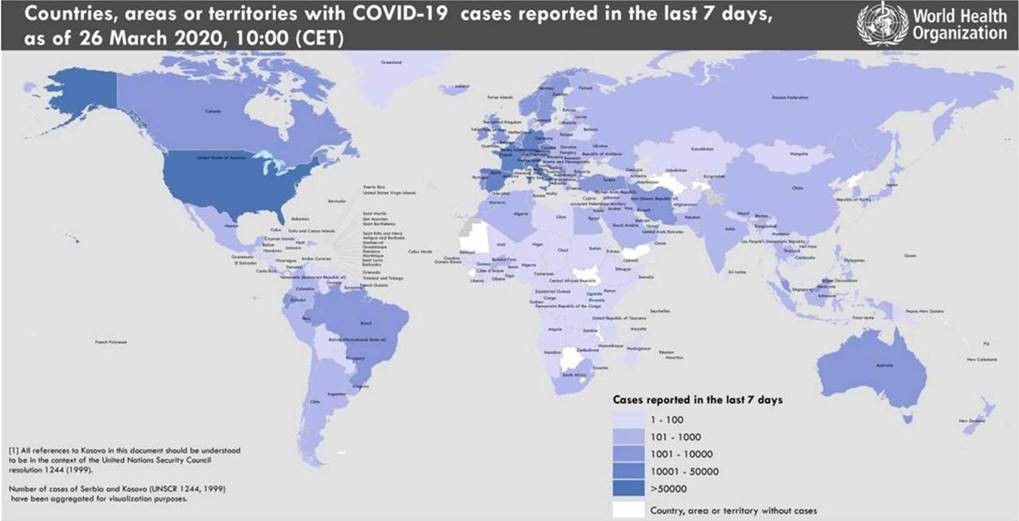
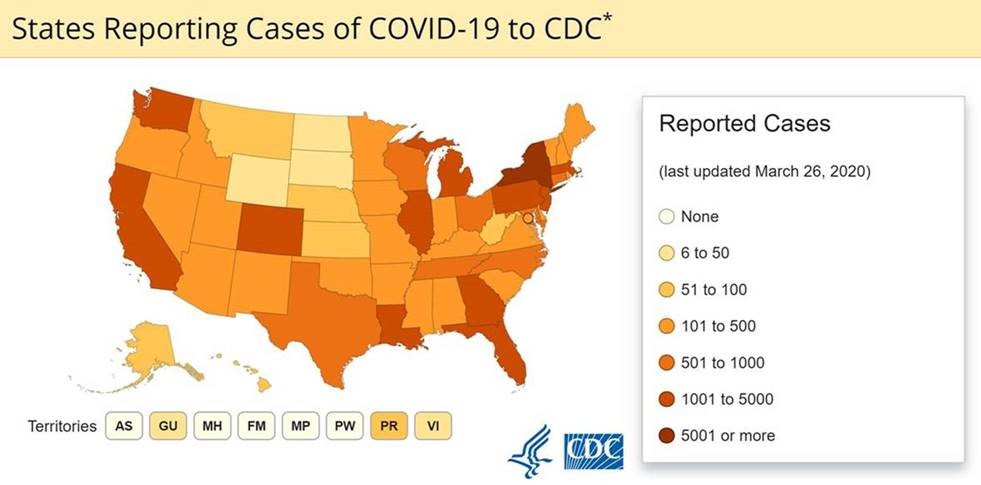
Map last updated 3/26. Note there is still no 1-5 category
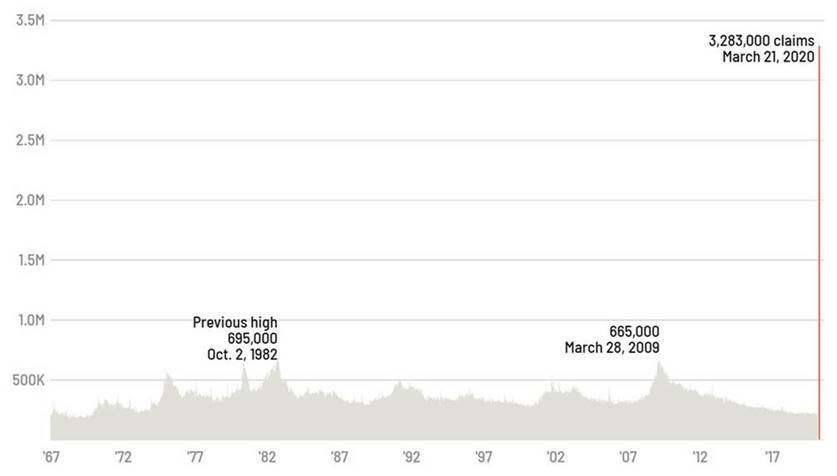
Unemployment insurance claims, U.S. Department of Labor
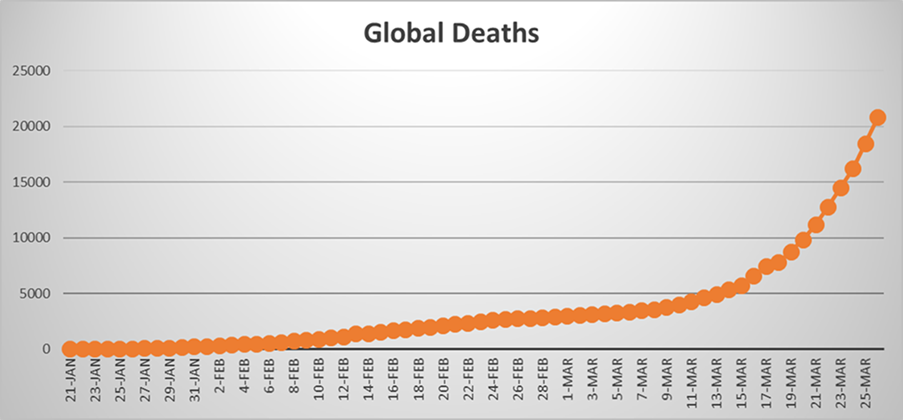
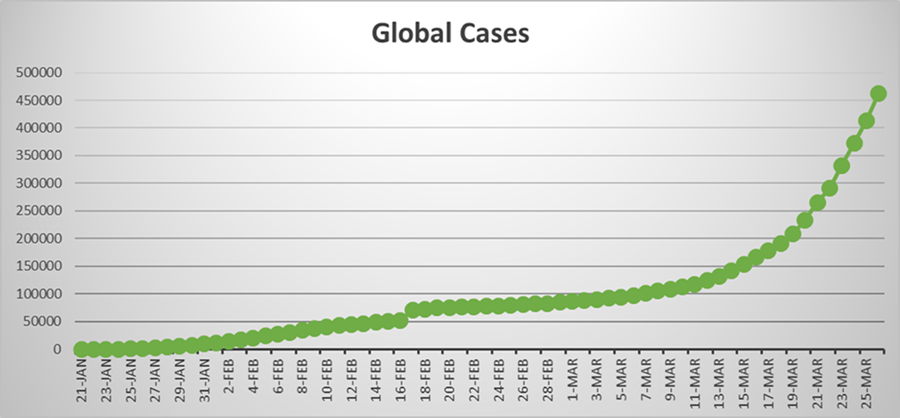
(data from WHO daily situation reports)
For more information, visit CDC’s Novel Coronavirus 2019 website | | | |
(READ MORE)
March 17, 2020 | Legislative Update 2020 - Week #8
| Bill Tracker: Bills that crossed over are in GREEN. Bills that did not cross over are in RED. For bills in green click to bill number to link to the full text of the bill. | | | HB 23 – Statutory Authority for Broadband: EMCs
Bill Sponsor: Rep. Houston
Bill Status: Introduced 1/16/19. Referred to Economic Development & Tourism. House Passed by Substitute 2/11/19. Senate Referred to Regulated Industries and Utilities. Committee Favorably Reported by Substitute 3/28/19. Senate Tabled 3/29/19. Senate Recommitted 1/13/20.
Summary: To specifically authorize Electric Membership Corporations (EMCs) & their affiliates to provide broadband services (aka “statutory authority”)
HB 184 – Small Cell Wireless
Bill Sponsor: Rep. Harrell
Bill Status: Introduced 2/8/19. Referred to Economic Development & Tourism. House Passed by Substitute 2/14/19. Senate Referred to Regulated Industries and Utilities. Committee Favorably Reported 3/14/19. Senate Recommitted 1/13/20.
Summary: To encourage small cell wireless deployment through the colocation of new equipment on already-existing infrastructure.
HB 730 – Sales and Use Tax Exemption for Major Sporting Event Properties
Bill Sponsor: Rep. Stephens
Bill Status: Introduced 1/13/20. Referred to Ways & Means.
Summary: To exempt all tangible personal property from taxation when sold to or used by a local host committee for major sporting events.
HB 740 – Creation of a Sports Marketing Fund
Bill Sponsor: Rep. Stephens
Bill Status: Introduced 1/13/20. Referred to Economic Development and Tourism.
Summary: To create a Sports Marketing Fund and Sports Marketing Board to provide funding to sports commissions.
HB 749 – Protection of Naturally Occurring Affordable Housing
Bill Sponsor: Rep. McLaurin
Bill Status: Introduced 2/3/20. Referred to Governmental Affairs.
Summary: To provide for the protection of naturally occurring affordable housing and naturally occurring workforce housing in certain designated areas.
HB 782 – Revise the Number of State Holidays Observed
Bill Sponsor: Rep. McLeod
Bill Status: Introduced 1/16/20. Referred to Governmental Affairs.
Summary: To designate the Tuesday following the first Monday in November of each year as a state holiday.
HB 788 – Extend the Sunset for a Manufacturer's Exemption
Bill Sponsor: Rep. Corbett
Bill Status: Introduced 1/27/20. Referred to Ways & Means.
Summary: To extend the sunset on a manufacturer’s exemption from 2020 to 2025 for maintenance and replacement parts for machinery or equipment used for concrete.
HB 792 – AFY 2020 Budget
Bill Sponsor: Speaker Ralston
Bill Status: Introduced 1/27/20. Referred to Appropriations. Passed House by Substitute 2/19/20. Senate Referred to Appropriations. Senate Passed by Substitute 3/4/20. House and Senate Conference Committee 3/5/20. House and Senate Conference Committee Reported 3/12/20. Sent to Governor 3/12/20.
Summary: The amended budget for the fiscal year beginning July 1, 2019 to June 30, 2020.
HB 793 – FY 2021 Budget
Bill Sponsor: Speaker Ralston
Bill Status: Introduced 1/27/20. Referred to Appropriations. Passed House by Substitute 3/10/20. Senate Referred to Appropriations 3/10/20.
Summary: The budget for the fiscal year beginning July 1, 2020 to June 30, 2021.
HB 794 – AFY 2020 Budget
Bill Sponsor: Speaker Ralston
Bill Status: Introduced 1/27/20. Referred to Appropriations.
Summary: The amended budget for the fiscal year beginning July 1, 2019 to June 30, 2020.
HB 795 – AFY 2020 Budget
Bill Sponsor: Speaker Ralston
Bill Status: Introduced 1/27/20. Referred to Appropriations.
Summary: The amended budget for the fiscal year beginning July 1, 2019 to June 30, 2020.
HB 796 – FY 2021 Budget
Bill Sponsor: Speaker Ralston
Bill Status: Introduced 1/27/20. Referred to Appropriations.
Summary: The budget for the fiscal year beginning July 1, 2020 to June 30, 2021
HB 797 – FY 2021 Budget
Bill Sponsor: Speaker Ralston
Bill Status: Introduced 1/27/20. Referred to Appropriations.
Summary: The budget for the fiscal year beginning July 1, 2020 to June 30, 2021
HB 820 – State Investment in Railroad and Railway Facilities
Bill Sponsor: Rep. Tanner
Bill Status: Introduced 1/28/20. Referred to Transportation. House Passed 2/24/20. Senate Referred to Transportation. Committee Favorably Reported 3/4/20.
Summary: Relating to officers in the Department of Transportation, so as to provide for state investment in railways and railroad facilities and equipment
HB 827 – Creation of Georgia Major Sporting Event Reimbursement Fund and Board
Bill Sponsor: Rep. Stephens
Bill Status: Introduced 1/29/20. Referred to Ways & Means.
Summary: To create a fund for non-recurring sports events to allot money not exceeding one-third of the cost of hosting the event towards the preparation, presentation, and execution of each event.
HB 834 – Revision of the Term “undertaking” Regarding Revenue Bonds
Bill Sponsor: Rep. Jasperse
Bill Status: Introduced 1/29/20. Referred to Governmental Affairs.
Summary: To revise the term “undertaking” to include the provision of access to the internet in regard to revenue bonds.
HB 837 – Alteration of the Approval Process of County Development Authorities under Certain Conditions
Bill Sponsor: Rep. Martin
Bill Status: Introduced 1/29/20. Referred to Ways & Means.
Summary: To require counties where 95% of the land area is incorporated into one or more municipalities to gain approval from the board of education or municipality before undertaking projects, acquiring titles to property, or granting tax abatements.
HB 839 – Change Definition of Employment
Bill Sponsor: Rep. Jones, T.
Bill Status: Introduced 1/30/20. Referred to Industry and Labor.
Summary: To change the definition of employment to include services performed by an individual for wages unless the Department of Labor makes a contrary determination.
HB 850 – Taxes to Provide for Uniform November Referenda and Elections
Bill Sponsor: Rep. Ridley
Bill Status: Introduced 1/30/20. Referred to Ways & Means.
Summary: Relating to sales and use taxes, so as to provide for uniform November referenda and elections for local option sales taxes.
HB 887 – Increasing the Maximum Amount of Distilled Spirits a Manufacturer Can Sell per Consumer
Bill Sponsor: Rep. Stephens
Bill Status: Introduced 2/5/20. Referred to Regulated Industries.
Summary: Increasing the maximum amount of off-premise liquor consumed per customer from 2,250 to 4,500 milliliters of distilled spirits per day
HB 889 – Creation of the Toombs County Public Facilities Authority
Bill Sponsor: Rep. Morris
Bill Status: Introduced 2/5/20. Referred to Intragovernmental Coordination. House Passed 2/19/20. Senate Referred to State and Local Government Operations. Senate Passed 2/26/20.
Summary: Creating the Toombs County Public Facilities Authority and establishing the appointments of members of the authority.
HB 891 – Eliminate Need of the Term “Primary” to Allow for Sales Tax Exemptions for Performances and Exhibitions
Bill Sponsor: Rep. Gambill
Bill Status: Introduced 2/5/20. Referred to Ways & Means.
Summary: To make it so the mission to advance arts in this state shall not be required to be an organization's primary mission in order to obtain an exemption for certain sales of tickets, fees, or charges for admission.
HB 920 – Allow for Out-of-State Tuition Waiver
Bill Sponsor: Rep. Clark
Bill Status: Introduced 2/19/20. Referred to Higher Education.
Summary: To allow for students, including undocumented students, to be eligible for out-of-state tuition waivers if they meet the requirements of attending a Georgia secondary school for three consecutive years, applying for enrollment in a post-secondary institution within 24 months of completing secondary education, and providing official transcripts verifying attendance and graduation.
HB 930 – Changes to “Georgia Agribusiness and Rural Jobs Act”
Bill Sponsor: Rep. Corbett
Bill Status: Introduced 2/19/20. Referred to Ways & Means.
Summary: To increase the population considered rural from 50,000 to 75,000, and to certify an additional $100 million in capital investments.
HB 970 – Income Tax Credit for Historic Structure Rehabilitation
Bill Sponsor: Rep. Smith, V.
Bill Status: Introduced 2/21/20. Referred to Ways and Means.
Summary: To revise procedures, conditions, and limitations relating to tax credits for the rehabilitation of historic structures.
HB 976 – Bulloch County Public Facilities Authority Act
Bill Sponsor: Rep. Tankersley
Bill Status: Introduced 2/21/20. Referred to Intragovernmental Coordination. House Passed 2/25/20. Senate Referred to State and Local Government Operations. Senate Passed 3/3/20.
Summary: To create the Bulloch County Public Facilities Authority and to provide for the appointment of members of the authority.
HB 986 – Limitations on Directors of Development Authorities and on the Purchasing of Property by Certain Development Authorities
Bill Sponsor: Rep. Jackson
Bill Status: Introduced 2/21/20. Referred to Governmental Affairs.
Summary: To provide that members of a county or municipal governing authority appointed as directors of development authorities shall not serve as chairpersons or chief executive officers of such authorities and to provide that county development authorities for certain counties must obtain the consent of certain municipalities and school systems to acquire property or undertake projects within such municipalities.
HB 992 – Tax Credit for Investors in Women Owned Businesses
Bill Sponsor: Rep. Scott
Bill Status: Introduced 2/24/20. Referred to Ways and Means.
Summary: Relating to income taxes, so as to provide for an income tax credit for investors in women owned businesses.
HB 1002 – Georgia Income Tax and Determining Federal Income Tax
Bill Sponsor: Rep. Harrell
Bill Status: Introduced 2/25/20. Referred to Ways and Means. Committee Favorably Reported 3/9/20.
Summary: Relating to imposition, rate, computation of, and exemptions from income taxes, so as to add Georgia income tax paid by an individual to Georgia taxable net income to the extent such tax was deducted in determining federal taxable income.
HB 1004 – Certain Credits for Higher Education
Bill Sponsor: Rep. Stephens
Bill Status: Introduced 2/25/20. Referred to Ways and Means.
Summary: To provide for income tax credits for higher education for the Fort Gordon Cyber Security and Information Technology Innovation Corridor and the Savannah Logistics Technology Innovation Corridor.
HB 1011 – Proper Funding for Historic Property
Bill Sponsor: Rep. Frye
Bill Status: Introduced 2/25/20. Referred to Natural Resources and the Environment
Summary: Relating to powers, duties, and authority of the Department of Natural Resources and its Division of Historic Preservation and historic preservation grant program, so as to provide for and revise definitions.
HB 1012 – Georgia Entertainment Industry Investment Act
Bill Sponsor: Rep. Werkheiser
Bill Status: Introduced 2/25/20. Referred to Ways and Means.
Summary: Relating to the "Georgia Entertainment Industry Investment Act," so as to disallow and recapture any tax credit earned, claimed, transferred, or sold by a production company or qualified interactive entertainment production company that violates state or federal child labor laws or rules.
HB 1056 – Encompass Certain Transactions of Digital Goods and Services
Bill Sponsor: Rep. Harrell
Bill Status: Introduced 2/28/20. Referred to Ways and Means.
Summary: To expand sales and use taxation to encompass certain transactions of digital goods and services.
HB 1089 – Streamline Litigation Process and Reduce Costs
Bill Sponsor: Rep. McCall
Bill Status: Introduced 3/4/20. Referred to the Special Committee on Access to the Civil Justice System.
Summary: To streamline the process of litigation and reduce costs for Georgia's industries, small businesses, and citizens by amending multiple code sections.
HB 1113 – Tax Credit for Dentists, Nurse Practitioners, and Physician Assistants
Bill Sponsor: Rep. Barton
Bill Status: Introduced 3/5/20. Referred to Ways and Means.
Summary: To expand the tax credit for rural physicians to dentists, nurse practitioners, and physician assistants.
HR 306 – Reduction of Personal and Corporate Income Tax Rate
Bill Sponsor: Rep. Efstration
Bill Status: Introduced 2/22/19. Referred to Ways & Means.
Bill Summary: To provide for a reduction in the highest personal and corporate income tax rates by 0.25 percent.
HR 876 – Urge Congress to Remove Cannabis from the Controlled Substance Act
Bill Sponsor: Rep. Kendrick
Bill Status: Introduced 1/29/20. Referred to Special Rules.
Summary: To urge Congress to enact legislation that would remove cannabis from the federal Controlled Substance.
HR 1060 – House Study Committee on Business and Legal Immigration
Bill Sponsor: Rep. Cantrell
Bill Status: Introduced 2/5/20. Referred to Special Rules.
Summary: A resolution creating the House Study Committee on Business and Legal Immigration; and for other purposes.
HR 1304 – Classification of Qualified Affordable Building Projects
Bill Sponsor: Rep. Knight
Bill Status: Introduced 2/28/20. Referred to Ways and Means.
Summary: To provide that qualified affordable building projects may be classified as a separate class of property for ad valorem property tax purposes, and different rates, methods, and assessment dates may be provided for such building projects and to provide for the submission of this amendment for ratification or rejection
SB 20 – Banking Improvement Zones
Bill Sponsor: Sen. Rhett
Bill Status: Introduced 1/16/19. Referred to Banking and Financial Institutions. Senate Passed 2/27/19. House Referred to Banks & Banking. House Passed by Substitute 4/2/19. Senate Disagreed to House Substitute 2/4/20.
Summary: A bill to establish “banking improvement zones” to encourage opening of banks in areas underserved by banks.
SB 43 – Definition of the Term “Undertaking”
Bill Sponsor: Sen. Payne
Bill Status: Introduced 2/5/19. Referred to Regulated Industries and Utilities. Senate Passed 2/25/19. House Referred to Energy, Utilities, & Telecommunications. House Committee Favorably Reported 1/29/20.
Summary: Relating to revenue bonds, so as to revise the definition of the term "undertaking" as it relates to electric systems
SB 110 – Statewide Business Court
Bill Sponsor: Sen. Stone
Bill Status: Introduced 2/15/19. Referred to Judiciary. Senate Passed by Substitute 3/7/19. House Referred to Judiciary. House Passed by Substitute 3/25/19. Conference Committee Appointed 3/29/19. House Conference Committee Report Adopted 4/2/19. Senate Conference Report Lost, Senate Tabled 3/5/20.
Summary: Legislation to create a statewide business court.
SB 119 – Georgia Measuring Success Act
Bill Sponsor: Sen. Albers
Bill Status: Introduced 2/19/19. Referred to Finance. Senate Passed 3/4/1. House Referred to Ways & Means. House Passed by Substitute 3/28/19.
Summary: A bill relating to fiscal bills generally, so as to require an economic analysis prior to the introduction or amendment of legislation containing tax incentives or modifying or extending existing tax incentives.
SB 131 – Georgia Major Airport Authority Act
Bill Sponsor: Sen. Jones, B.
Bill Status: Introduced 2/20/19. Referred to Transportation. Senate Passed by Substitute 3/7/19. House Referred to Rules. House Passed by Substitute 3/28/19.
Summary: A bill relating to aviation, so as to create the Georgia Major Airport Authority. The bill amends Article 1 of Chapter 15 of Title 45 of the O.C.G.A., to general provisions relative to the Attorney General, so as to provide for representation of the Georgia Major Airport Authority by the Attorney General.
SB 162 – Disaster Mitigation Improvements and Broadband Services Infrastructure
Bill Sponsor: Sen. Brass
Bill Status: Introduced 1/25/19. Referred to Regulated Industries and Utilities. Senate Passed by Substitute 3/7/19. House Referred to Energy, Utilities & Telecommunications. Committee Favorably Reported by Substitute 3/28/20. House Withdrawn, Recommitted 4/2/19.
Summary: A bill relating to local government, so as to provide for disaster mitigation improvements and broadband services infrastructure in projects of downtown development authorities and development authorities.
SB 309 – Georgia Municipal and Local Government Infrastructure Finance Authority Act
Bill Sponsor: Sen. Stone
Bill Status: Introduced 1/28/20. Referred to State and Local Governmental Operations. Committee Favorably Reported by Substitute 2/19/20. Read Second Time 2/20/20.
Summary: To create the Georgia Municipal and Local Government Infrastructure Finance Authority to provide a mechanism through which local governments may finance infrastructure at lower than prevailing costs to be available to the largest number of local governments feasible.
SB 322 – Development Impact Fees
Bill Sponsor: Sen. Ginn
Bill Status: Introduced 1/29/20. Referred to Economic Development and Tourism. Senate Passed by Substitute 2/21/20. House Referred to Governmental Affairs 2/24/20.
Summary: Relating to development impact fees, so as to authorize the exemption of certain development projects from funding such projects' proportionate share of system improvement under certain circumstances
SB 345 – Standards, Labeling, and Adulteration of Food of Nonprofit Organizations
Bill Sponsor: Sen. Kirkpatrick
Bill Status: Introduced 2/3/20. Referred to Health and Human Services. Senate Passed by Substitute 2/20/20. House Referred to Health & Human Services. Committee Favorably Reported 3/2/20.
Summary: Relating to development impact fees, so as to authorize the exemption of certain development projects from funding such projects' proportionate share of system improvement under certain circumstances
SB 363 – Computation of Taxable Net Income with Exemption for Military Retirement
Bill Sponsor: Sen. Unterman
Bill Status: Introduced 2/5/20. Referred to Finance.
Summary: Relating to computation of taxable net income, so as to provide an exemption for military retirement income.
SB 366 – Brady Law Regulations and Universal Background Checks
Bill Sponsor: Sen. Karinshak
Bill Status: Introduced 2/5/20. Referred to Judiciary.
Summary: Relating to Brady Law regulations, so as to require universal background checks in all manner of firearm transfers and purchases.
SB 368 – Child-Placing Agencies Allowed to Prohibit Placement Due to Religious or Moral Convictions
Bill Sponsor: Sen. Harbin
Bill Status: Introduced 2/18/20. Referred to Judiciary.
Summary: To prohibit child-placing agencies from being required to perform, assist, counsel, recommend, consent to, refer, or participate in any placement of a child for foster care or adoption when the placement violates certain religious or moral convictions of the child-placing agency
SB 371 – Georgia Freight Railroad Program
Bill Sponsor: Sen. Gooch
Bill Status: Introduced 2/18/20. Referred to Transportation. Senate Passed by Substitute 2/28/20. House Referred to Transportation 3/3/20.
Summary: To create the Georgia Freight Railroad Program, which would include the Rail Enhancement Plan, Rail Preservation Plan, and Rail Industrial Plan. There will be an annual report made by the commissioner of transportation to report on the activities of the program.
SB 403 – Allow for Lottery Game of Sports Wagering
Bill Sponsor: Sen. Jones, B
Bill Status: Introduced 2/21/20. Referred to Regulated Industries and Utilities.
Summary: To provide for the lottery game of sports wagering in this state as a part of the Lottery for Education.
SB 404 – Development Impact Fees for Education
Bill Sponsor: Sen. Dolezal
Bill Status: Introduced 2/21/20. Referred to Education and Youth. Committee Favorably Reported by Substitute 3/5/20. Senate Tabled 3/12/20.
Summary: To provide for the option of development impact fees to pay for a share of the cost of additional educational facilities to serve new growth and development.
SB 420 – Nondiscrimination in Public Use of Restrooms
Bill Sponsor: Sen. Jones, E.
Bill Status: Introduced 2/24/20. Referred to Health and Human Services. Committee Favorably Reported by Substitute 3/3/20.
Summary: To provide that if a food sales establishment permits members of the public to use its restroom facilities, it must do so without discriminating on the basis of race, color, religion, national origin, sex, disability, or age and must maintain the restrooms in a clean and serviceable condition.
SB 425 – Reconstitution of the Ocilla-Irwin County Industrial Development Authority
Bill Sponsor: Sen. Harper
Bill Status: Introduced 2/24/20. Referred to State and Local Governmental Operations.
Summary: To reconstitute the Ocilla-Irwin County Industrial Development Authority.
SB 441 – Expenditures of a Production Company's State Certified Productions May Be Combined to Meet Spending Thresholds
Bill Sponsor: Sen. Mullis
Bill Status: Introduced 2/26/20. Referred to Finance. Committee Favorably Reported by Substitute 3/9/20.
Summary: To provide that all expenditures of a production company's state certified productions may be combined to meet spending thresholds, to lower spending thresholds, to increase the value of the tax credit, to lower the cap on credits for certain years, to provide for transferability of the tax credit, and to provide for conditions and limitations.
SB 444 – Alternate Process to Condemn Certain Blighted Properties
Bill Sponsor: Sen. Jones, H.
Bill Status: Introduced 2/26/20. Referred to Government Oversight.
Summary: To provide for an alternative process for a county, municipality, or consolidated government to condemn certain blighted properties.
SB 450 – Ocilla-Irwin County Industrial Development Authority
Bill Sponsor: Sen. Harper
Bill Status: Introduced 2/27/20. Referred to State and Local Governmental Operations. Passed Senate 2/28/20. House referred to Intragovernmental Coordination 3/2/20. House Committee Favorably Reported 3/10/20. House Passed 3/10/20.
Summary: To amend an Act to reconstitute the Ocilla-Irwin County Industrial Development Authority so as to change the membership of said Authority.
SR 237 – Congressional Term Limits
Bill Sponsor: Sen. Cowsert
Bill Status: Introduced 2/22/19. Referred to Rules. Senate Passed 3/7/19. House Referred to Rules 3/11/19.
Summary: A resolution urging Congress to call a convention to address term limits so as to limit the number of terms Members of Congress may serve. It would only be effective if 2/3 of the states passed.
SR 776 – Constitutional Amendment to Allow School Boards to Collect Development Fees
Bill Sponsor: Sen. Dolezal
Bill Status: Introduced 2/21/20. Referred to Education and Youth. Committee Favorably Reported 3/5/20. Senate Tabled 3/12/20.
Summary: An amendment to the Constitution so as to provide that the General Assembly may by general law authorize local boards of education to impose, levy, and collect development impact fees and use the proceeds to pay for a share of the cost of additional educational facilities.
SR 821 – Lotteries, Nonprofit Bingo Games, and Sports Betting
Bill Sponsor: Sen. Jones, B.
Bill Status: Introduced 2/26/20. Referred to Regulated Industries and Utilities.
Summary: So as to provide for sports betting in this state under certain circumstances.
SR 885 – General Obligation Debt
Bill Sponsor: Sen. Harper
Bill Status: Introduced 3/4/20. Referred to Transportation. Committee Favorably Reported 3/9/20. Senate Passed by Substitute 3/12/20.
Summary: So as to authorize the state to incur general obligation debt in order to make loans or grants to certain counties, municipalities, consolidated governments, and local authorities that own airports for the acquisition, construction, development, extension, enlargement, or improvement of such airports.
| | | |
(READ MORE)
March 8, 2020 | Legislative Update 2020 - Week #7
| Bill Tracker: Because many bills GEDA monitored last session are still active, the bill tracker has carried over from the last legislative session. As always please let us know if you become aware of legislation you would like us to monitor. | | | HB 23 – Statutory Authority for Broadband: EMCs
Bill Sponsor: Rep. Houston
Bill Status: Introduced 1/16/19. Referred to Economic Development & Tourism. House Passed by Substitute 2/11/19. Senate Referred to Regulated Industries and Utilities. Committee Favorably Reported by Substitute 3/28/19. Senate Tabled 3/29/19. Senate Recommitted 1/13/20.
Summary: To specifically authorize Electric Membership Corporations (EMCs) & their affiliates to provide broadband services (aka “statutory authority”)
HB 184 – Small Cell Wireless
Bill Sponsor: Rep. Harrell
Bill Status: Introduced 2/8/19. Referred to Economic Development & Tourism. House Passed by Substitute 2/14/19. Senate Referred to Regulated Industries and Utilities. Committee Favorably Reported 3/14/19. Senate Recommitted 1/13/20.
Summary: To encourage small cell wireless deployment through the colocation of new equipment on already-existing infrastructure.
HB 730 – Sales and Use Tax Exemption for Major Sporting Event Properties
Bill Sponsor: Rep. Stephens
Bill Status: Introduced 1/13/20. Referred to Ways & Means.
Summary: To exempt all tangible personal property from taxation when sold to or used by a local host committee for major sporting events.
HB 740 – Creation of a Sports Marketing Fund
Bill Sponsor: Rep. Stephens
Bill Status: Introduced 1/13/20. Referred to Economic Development and Tourism.
Summary: To create a Sports Marketing Fund and Sports Marketing Board to provide funding to sports commissions.
HB 749 – Protection of Naturally Occurring Affordable Housing
Bill Sponsor: Rep. McLaurin
Bill Status: Introduced 2/3/20. Referred to Governmental Affairs.
Summary: To provide for the protection of naturally occurring affordable housing and naturally occurring workforce housing in certain designated areas.
HB 782 – Revise the Number of State Holidays Observed
Bill Sponsor: Rep. McLeod
Bill Status: Introduced 1/16/20. Referred to Governmental Affairs.
Summary: To designate the Tuesday following the first Monday in November of each year as a state holiday.
HB 788 – Extend the Sunset for a Manufacturer's Exemption
Bill Sponsor: Rep. Corbett
Bill Status: Introduced 1/27/20. Referred to Ways & Means.
Summary: To extend the sunset on a manufacturer’s exemption from 2020 to 2025 for maintenance and replacement parts for machinery or equipment used for concrete.
HB 792 – AFY 2020 Budget
Bill Sponsor: Speaker Ralston
Bill Status: Introduced 1/27/20. Referred to Appropriations. Passed House by Substitute 2/19/20. Senate Referred to Appropriations. Senate Passed by Substitute 3/4/20. House Conference Committee 3/5/20.
Summary: The amended budget for the fiscal year beginning July 1, 2019 to June 30, 2020.
HB 793 – FY 2021 Budget
Bill Sponsor: Speaker Ralston
Bill Status: Introduced 1/27/20. Referred to Appropriations.
Summary: The budget for the fiscal year beginning July 1, 2020 to June 30, 2021
HB 794 – AFY 2020 Budget
Bill Sponsor: Speaker Ralston
Bill Status: Introduced 1/27/20. Referred to Appropriations.
Summary: The amended budget for the fiscal year beginning July 1, 2019 to June 30, 2020
HB 795 – AFY 2020 Budget
Bill Sponsor: Speaker Ralston
Bill Status: Introduced 1/27/20. Referred to Appropriations.
Summary: The amended budget for the fiscal year beginning July 1, 2019 to June 30, 2020
HB 796 – FY 2021 Budget
Bill Sponsor: Speaker Ralston
Bill Status: Introduced 1/27/20. Referred to Appropriations.
Summary: The budget for the fiscal year beginning July 1, 2020 to June 30, 2021
HB 797 – FY 2021 Budget
Bill Sponsor: Speaker Ralston
Bill Status: Introduced 1/27/20. Referred to Appropriations.
Summary: The budget for the fiscal year beginning July 1, 2020 to June 30, 2021
HB 820 – State Investment in Railroad and Railway Facilities
Bill Sponsor: Rep. Tanner
Bill Status: Introduced 1/28/20. Referred to Transportation. House Passed 2/24/20. Senate Referred to Transportation. Committee Favorably Reported 3/4/20.
Summary: Relating to officers in the Department of Transportation, so as to provide for state investment in railways and railroad facilities and equipment
HB 827 – Creation of Georgia Major Sporting Event Reimbursement Fund and Board
Bill Sponsor: Rep. Stephens
Bill Status: Introduced 1/29/20. Referred to Ways & Means.
Summary: To create a fund for non-recurring sports events to allot money not exceeding one-third of the cost of hosting the event towards the preparation, presentation, and execution of each event.
HB 834 – Revision of the Term “undertaking” Regarding Revenue Bonds
Bill Sponsor: Rep. Jasperse
Bill Status: Introduced 1/29/20. Referred to Governmental Affairs.
Summary: To revise the term “undertaking” to include the provision of access to the internet in regard to revenue bonds.
HB 837 – Alteration of the Approval Process of County Development Authorities under Certain Conditions
Bill Sponsor: Rep. Martin
Bill Status: Introduced 1/29/20. Referred to Ways & Means.
Summary: To require counties where 95% of the land area is incorporated into one or more municipalities to gain approval from the board of education or municipality before undertaking projects, acquiring titles to property or granting tax abatements.
HB 839 – Change Definition of Employment
Bill Sponsor: Rep. Jones
Bill Status: Introduced 1/30/20. Referred to Industry and Labor.
Summary: To change the definition of employment to include services performed by an individual for wages unless the Department of Labor makes a contrary determination.
HB 850 – Taxes to Provide for Uniform November Referenda and Elections
Bill Sponsor: Rep. Ridley
Bill Status: Introduced 1/30/20. Referred to Ways & Means.
Summary: Relating to sales and use taxes, so as to provide for uniform November referenda and elections for local option sales taxes.
HB 887 – Increasing the Maximum Amount of Distilled Spirits a Manufacturer Can Sell per Consumer
Bill Sponsor: Rep. Stephens
Bill Status: Introduced 2/5/20. Referred to Regulated Industries.
Summary: Increasing the maximum amount of off-premise liquor consumed per customer from 2,250 to 4,500 milliliters of distilled spirits per day
HB 889 – Creation of the Toombs County Public Facilities Authority
Bill Sponsor: Rep. Morris
Bill Status: Introduced 2/5/20. Referred to Intragovernmental Coordination. House Passed 2/19/20. Senate Referred to State and Local Government Operations. Senate Passed 2/26/20.
Summary: Creating the Toombs County Public Facilities Authority and establishing the appointments of members of the authority.
HB 891 – Eliminate Need of the Term “Primary” to Allow for Sales Tax Exemptions for Performances and Exhibitions
Bill Sponsor: Rep. Gambill
Bill Status: Introduced 2/5/20. Referred to Ways & Means.
Summary: To make it so the mission to advance arts in this state shall not be required to be an organization's primary mission in order to obtain an exemption for certain sales of tickets, fees or charges for admission.
HB 920 – Allow for Out-of-State Tuition Waiver
Bill Sponsor: Rep. Clark
Bill Status: Introduced 2/19/20. Referred to Higher Education.
Summary: To allow for students, including undocumented students, to be eligible for out-of-state tuition waivers if they meet the requirements of attending a Georgia secondary school for three consecutive years, applying for enrollment in a post-secondary institution within 24 months of completing secondary education, and providing official transcripts verifying attendance and graduation.
HB 930 – Changes to Georgia Agribusiness and Rural Jobs Act
Bill Sponsor: Rep. Corbett
Bill Status: Introduced 2/19/20. Referred to Ways & Means.
Summary: To increase the population considered rural from 50,000 to 75,000, and to certify an additional $100 million in capital investments.
HB 970 – Income Tax Credit for Historic Structure Rehabilitation
Bill Sponsor: Rep. Smith, V.
Bill Status: Introduced 2/21/20. Referred to Ways and Means.
Summary: To revise procedures, conditions and limitations relating to tax credits for the rehabilitation of historic structures.
HB 976 – Bulloch County Public Facilities Authority Act
Bill Sponsor: Rep. Tankersley
Bill Status: Introduced 2/21/20. Referred to Intragovernmental Coordination. House Passed 2/25/20. Senate Referred to State and Local Government Operations. Senate Passed 3/3/20.
Summary: To create the Bulloch County Public Facilities Authority and to provide for the appointment of members of the authority.
HB 986 – Limitations on Directors of Development Authorities and on the Purchasing of Property by Certain Development Authorities
Bill Sponsor: Rep. Jackson
Bill Status: Introduced 2/21/20. Referred to Governmental Affairs.
Summary: To provide that members of a county or municipal governing authority appointed as directors of development authorities shall not serve as chairpersons or chief executive officers of such authorities and to provide that county development authorities for certain counties must obtain the consent of certain municipalities and school systems to acquire property or undertake projects within such municipalities.
HB 992 – Tax Credit for Investors in Women Owned Businesses
Bill Sponsor: Rep. Scott
Bill Status: Introduced 2/24/20. Referred to Ways and Means.
Summary: Relating to income taxes, so as to provide for an income tax credit for investors in women owned businesses.
HB 1002 – Georgia Income Tax and Determining Federal Income Tax
Bill Sponsor: Rep. Harrell
Bill Status: Introduced 2/25/20. Referred to Ways and Means.
Summary: Relating to imposition, rate, computation of, and exemptions from income taxes, so as to add Georgia income tax paid by an individual to Georgia taxable net income to the extent such tax was deducted in determining federal taxable income.
HB 1004 – Certain Credits for Higher Education
Bill Sponsor: Rep. Stephens
Bill Status: Introduced 2/25/20. Referred to Ways and Means.
Summary: To provide for income tax credits for higher education for the Fort Gordon Cyber Security and Information Technology Innovation Corridor and the Savannah Logistics Technology Innovation Corridor.
HB 1011 – Proper Funding for Historic Property
Bill Sponsor: Rep. Frye
Bill Status: Introduced 2/25/20. Referred to Natural Resources and the Environment
Summary: Relating to powers, duties, and authority of the Department of Natural Resources and its Division of Historic Preservation and historic preservation grant program, so as to provide for and revise definitions.
HB 1012 – Georgia Entertainment Industry Investment Act
Bill Sponsor: Rep. Werkheiser
Bill Status: Introduced 2/25/20. Referred to Ways and Means.
Summary: Relating to the "Georgia Entertainment Industry Investment Act," so as to disallow and recapture any tax credit earned, claimed, transferred, or sold by a production company or qualified interactive entertainment production company that violates state or federal child labor laws or rules.
HB 1056 – Encompass Certain Transactions of Digital Goods and Services
Bill Sponsor: Rep. Harrell
Bill Status: Introduced 2/28/20. Referred to Ways and Means.
Summary: To expand sales and use taxation to encompass certain transactions of digital goods and services.
HB 1089 – Streamline Litigation Process and Reduce Costs
Bill Sponsor: Rep. McCall
Bill Status: Introduced 3/4/20. Referred to the Special Committee on Access to the Civil Justice System.
Summary: To streamline the process of litigation and reduce costs for Georgia's industries, small businesses, and citizens by amending multiple code sections.
HR 306 – Reduction of Personal and Corporate Income Tax Rate
Bill Sponsor: Rep. Efstration
Bill Status: Introduced 2/22/19. Referred to Ways & Means.
Bill Summary: To provide for a reduction in the highest personal and corporate income tax rates by 0.25 percent.
HR 876 – Urge Congress to Remove Cannabis from the Controlled Substance Act
Bill Sponsor: Rep. Kendrick
Bill Status: Introduced 1/29/20. Referred to Special Rules.
Summary: To urge Congress to enact legislation that would remove cannabis from the federal Controlled Substance.
HR 1060 – House Study Committee on Business and Legal Immigration
Bill Sponsor: Rep. Cantrell
Bill Status: Introduced 2/5/20. Referred to Special Rules.
Summary: A resolution creating the House Study Committee on Business and Legal Immigration; and for other purposes.
HR 1304 – Classification of Qualified Affordable Building Projects
Bill Sponsor: Rep. Knight
Bill Status: Introduced 2/28/20. Referred to Ways and Means.
Summary: To provide that qualified affordable building projects may be classified as a separate class of property for ad valorem property tax purposes, and different rates, methods, and assessment dates may be provided for such building projects and to provide for the submission of this amendment for ratification or rejection
SB 20 – Banking Improvement Zones
Bill Sponsor: Sen. Rhett
Bill Status: Introduced 1/16/19. Referred to Banking and Financial Institutions. Senate Passed 2/27/19. House Referred to Banks & Banking. House Passed by Substitute 4/2/19. Senate Disagreed to House Substitute 2/4/20.
Summary: A bill to establish “banking improvement zones” to encourage opening of banks in areas underserved by banks.
SB 43 – Definition of the Term “Undertaking”
Bill Sponsor: Sen. Payne
Bill Status: Introduced 2/5/19. Referred to Regulated Industries and Utilities. Senate Passed 2/25/19. House Referred to Energy, Utilities, & Telecommunications. House Committee Favorably Reported 1/29/20.
Summary: Relating to revenue bonds, so as to revise the definition of the term "undertaking" as it relates to electric systems
SB 110 – Statewide Business Court
Bill Sponsor: Sen. Stone
Bill Status: Introduced 2/15/19. Referred to Judiciary. Senate Passed by Substitute 3/7/19. House Referred to Judiciary. House Passed by Substitute 3/25/19. Conference Committee Appointed 3/29/19. House Conference Committee Report Adopted 4/2/19. Senate Conference Report Lost, Senate Tabled 3/5/20.
Summary: Legislation to create a statewide business court.
SB 119 – Georgia Measuring Success Act
Bill Sponsor: Sen. Albers
Bill Status: Introduced 2/19/19. Referred to Finance. Senate Passed 3/4/1. House Referred to Ways & Means. House Passed by Substitute 3/28/19.
Summary: A bill relating to fiscal bills generally, so as to require an economic analysis prior to the introduction or amendment of legislation containing tax incentives or modifying or extending existing tax incentives.
SB 131 – Georgia Major Airport Authority Act
Bill Sponsor: Sen. Jones, B.
Bill Status: Introduced 2/20/19. Referred to Transportation. Senate Passed by Substitute 3/7/19. House Referred to Rules. House Passed by Substitute 3/28/19.
Summary: A bill relating to aviation, so as to create the Georgia Major Airport Authority. The bill amends Article 1 of Chapter 15 of Title 45 of the O.C.G.A., to general provisions relative to the Attorney General, so as to provide for representation of the Georgia Major Airport Authority by the Attorney General.
SB 162 – Disaster Mitigation Improvements and Broadband Services Infrastructure
Bill Sponsor: Sen. Brass
Bill Status: Introduced 1/25/19. Referred to Regulated Industries and Utilities. Senate Passed by Substitute 3/7/19. House Referred to Energy, Utilities & Telecommunications. Committee Favorably Reported by Substitute 3/28/20. House Withdrawn, Recommitted 4/2/19.
Summary: A bill relating to local government, so as to provide for disaster mitigation improvements and broadband services infrastructure in projects of downtown development authorities and development authorities.
SB 309 – Georgia Municipal and Local Government Infrastructure Finance Authority Act
Bill Sponsor: Sen. Stone
Bill Status: Introduced 1/28/20. Referred to State and Local Governmental Operations. Committee Favorably Reported by Substitute 2/19/20. Read Second Time 2/20/20.
Summary: To create the Georgia Municipal and Local Government Infrastructure Finance Authority to provide a mechanism through which local governments may finance infrastructure at lower than prevailing costs to be available to the largest number of local governments feasible.
SB 322 – Development Impact Fees
Bill Sponsor: Sen. Ginn
Bill Status: Introduced 1/29/20. Referred to Economic Development and Tourism. Senate Passed by Substitute 2/21/20. House Referred to Governmental Affairs 2/24/20.
Summary: Relating to development impact fees, so as to authorize the exemption of certain development projects from funding such projects' proportionate share of system improvement under certain circumstances
SB 345 – Standards, Labeling, and Adulteration of Food of Nonprofit Organizations
Bill Sponsor: Sen. Kirkpatrick
Bill Status: Introduced 2/3/20. Referred to Health and Human Services. Senate Passed by Substitute 2/20/20. House Referred to Health & Human Services. Committee Favorably Reported 3/2/20.
Summary: Relating to development impact fees, so as to authorize the exemption of certain development projects from funding such projects' proportionate share of system improvement under certain circumstances
SB 363 – Computation of Taxable Net Income with Exemption for Military Retirement
Bill Sponsor: Sen. Unterman
Bill Status: Introduced 2/5/20. Referred to Finance.
Summary: Relating to computation of taxable net income, so as to provide an exemption for military retirement income.
SB 366 – Brady Law Regulations and Universal Background Checks
Bill Sponsor: Sen. Karinshak
Bill Status: Introduced 2/5/20. Referred to Judiciary.
Summary: Relating to Brady Law regulations, so as to require universal background checks in all manner of firearm transfers and purchases.
SB 368 – Child-Placing Agencies Allowed to Prohibit Placement Due to Religious or Moral Convictions
Bill Sponsor: Sen. Harbin
Bill Status: Introduced 2/18/20. Referred to Judiciary.
Summary: To prohibit child-placing agencies from being required to perform, assist, counsel, recommend, consent to, refer, or participate in any placement of a child for foster care or adoption when the placement violates certain religious or moral convictions of the child-placing agency
SB 371 – Georgia Freight Railroad Program
Bill Sponsor: Sen. Gooch
Bill Status: Introduced 2/18/20. Referred to Transportation. Senate Passed by Substitute 2/28/20. House Referred to Transportation 3/3/20.
Summary: To create the Georgia Freight Railroad Program, which would include the Rail Enhancement Plan, Rail Preservation Plan, and Rail Industrial Plan. There will be an annual report made by the commissioner of transportation to report on the activities of the program.
SB 403 – Allow for Lottery Game of Sports Wagering
Bill Sponsor: Sen. Jones, B
Bill Status: Introduced 2/21/20. Referred to Regulated Industries and Utilities.
Summary: To provide for the lottery game of sports wagering in this state as a part of the Lottery for Education.
SB 404 – Development Impact Fees for Education
Bill Sponsor: Sen. Dolezal
Bill Status: Introduced 2/21/20. Referred to Education and Youth. Committee Favorably Reported by Substitute 3/5/20.
Summary: To provide for the option of development impact fees to pay for a share of the cost of additional educational facilities to serve new growth and development.
SB 420 – Nondiscrimination in Public Use of Restrooms
Bill Sponsor: Sen. Jones, E
Bill Status: Introduced 2/24/20. Referred to Health and Human Services. Committee Favorably Reported by Substitute 3/3/20.
Summary: To provide that if a food sales establishment permits members of the public to use its restroom facilities, it must do so without discriminating on the basis of race, color, religion, national origin, sex, disability, or age and must maintain the restrooms in a clean and serviceable condition.
SB 425 – Reconstitution of the Ocilla-Irwin County Industrial Development Authority
Bill Sponsor: Sen. Harper
Bill Status: Introduced 2/24/20. Referred to State and Local Governmental Operations.
Summary: To reconstitute the Ocilla-Irwin County Industrial Development Authority.
SB 441 – Expenditures of a Production Company's State Certified Productions May Be Combined to Meet Spending Thresholds
Bill Sponsor: Sen. Mullis
Bill Status: Introduced 2/26/20. Referred to Finance.
Summary: To provide that all expenditures of a production company's state certified productions may be combined to meet spending thresholds, to lower spending thresholds, to increase the value of the tax credit, to lower the cap on credits for certain years, to provide for transferability of the tax credit and to provide for conditions and limitations.
SB 444 – Alternate Process to Condemn Certain Blighted Properties
Bill Sponsor: Sen. Jones, H.
Bill Status: Introduced 2/26/20. Referred to Government Oversight.
Summary: To provide for an alternative process for a county, municipality, or consolidated government to condemn certain blighted properties.
SB 450 – Ocilla-Irwin County Industrial Development Authority
Bill Sponsor: Sen. Harper
Bill Status: Introduced 2/27/20. Referred to State and Local Governmental Operations. Passed Senate 2/28/20. House referred to Intragovernmental Coordination 3/2/20.
Summary: To amend an Act to reconstitute the Ocilla-Irwin County Industrial Development Authority so as to change the membership of said Authority.
SR 237 – Congressional Term Limits
Bill Sponsor: Sen. Cowsert
Bill Status: Introduced 2/22/19. Referred to Rules. Senate Passed 3/7/19. House Referred to Rules 3/11/19.
Summary: A resolution urging Congress to call a convention to address term limits so as to limit the number of terms Members of Congress may serve. It would only be effective if 2/3 of the states passed.
SR 776 – Constitutional Amendment to Allow School Boards to Collect Development Fees
Bill Sponsor: Sen. Dolezal
Bill Status: Introduced 2/21/20. Referred to Education and Youth. Committee Favorably Reported 3/5/20.
Summary: An amendment to the Constitution so as to provide that the General Assembly may by general law authorize local boards of education to impose, levy, and collect development impact fees and use the proceeds to pay for a share of the cost of additional educational facilities.
SR 821 – Lotteries, Nonprofit Bingo Games, and Sports Betting
Bill Sponsor: Sen. Jones, B.
Bill Status: Introduced 2/26/20. Referred to Regulated Industries and Utilities.
Summary: So as to provide for sports betting in this state under certain circumstances.
SR 885 – General Obligation Debt
Bill Sponsor: Sen. Harper
Bill Status: Introduced 3/4/20. Referred to Transportation.
Summary: So as to authorize the state to incur general obligation debt in order to make loans or grants to certain counties, municipalities, consolidated governments, and local authorities that own airports for the acquisition, construction, development, extension, enlargement, or improvement of such airports. | | | |
(READ MORE)
March 1, 2020 | Legislative Update 2020 - Week #6
| Bill Tracker: Because many bills GEDA monitored last session are still active, the bill tracker has carried over from the last legislative session. As always please let us know if you become aware of legislation you would like us to monitor. | | | HB 23 – Statutory Authority for Broadband: EMCs
Bill Sponsor: Rep. Penny Houston
Bill Status: Senate Recommitted 1/13/20
Summary: To specifically authorize Electric Membership Corporations (EMCs) & their affiliates to provide broadband services (aka “statutory authority”)
HB 184 – Small Cell Wireless
Bill Sponsor: Rep. Brett Harrell
Bill Status: Senate Recommitted 1/13/20
Summary: To encourage small cell wireless deployment through the colocation of new equipment on already-existing infrastructure.
HB 730 – Sales and Use Tax Exemption for Major Sporting Event Properties
Bill Sponsor: Rep. Ron Stephens
Bill Status: Introduced 1/13/20. Referred to Ways & Means.
Summary: To exempt all tangible personal property from taxation when sold to or used by a local host committee for major sporting events.
HB 740 – Creation of a Sports Marketing Fund
Bill Sponsor: Rep. Ron Stephens
Bill Status: Introduced 1/13/20. Referred to Economic Development and Tourism.
Summary: To create a Sports Marketing Fund and Sports Marketing Board to provide funding to sports commissions.
HB 749 – Protection of Naturally Occurring Affordable Housing
Bill Sponsor: Rep. McLaurin
Bill Status: Introduced 2/3/20. Referred to Governmental Affairs.
Summary: To provide for the protection of naturally occurring affordable housing and naturally occurring workforce housing in certain designated areas.
HB 782 – Revise the Number of State Holidays Observed
Bill Sponsor: Rep. Donna McLeod
Bill Status: Introduced 1/15/20. Referred to Governmental Affairs.
Summary: To designate the Tuesday following the first Monday in November of each year as a state holiday.
HB 788 – Extend the Sunset for a Manufacturer's Exemption
Bill Sponsor: Rep. John Corbett
Bill Status: Introduced 1/16/20. Referred to Ways & Means.
Summary: To extend the sunset on a manufacturer’s exemption from 2020 to 2025 for maintenance and replacement parts for machinery or equipment used for concrete.
HB 792 – AFY 2020 Budget
Bill Sponsor: Speaker Ralston
Bill Status: Introduced 1/27/20. Referred to Appropriations. Passed House by Substitute 2/19/20. Senate Referred to Appropriations.
Summary: The amended budget for the fiscal year beginning July 1, 2019 to June 30, 2020
HB 793 – FY 2021 Budget
Bill Sponsor: Speaker Ralston
Bill Status: Introduced 1/27/20. Referred to Appropriations.
Summary: The budget for the fiscal year beginning July 1, 2020 to June 30, 2021
HB 794 – AFY 2020 Budget
Bill Sponsor: Speaker Ralston
Bill Status: Introduced 1/27/20. Referred to Appropriations.
Summary: The amended budget for the fiscal year beginning July 1, 2019 to June 30, 2020
HB 795 – AFY 2020 Budget
Bill Sponsor: Speaker Ralston
Bill Status: Introduced 1/27/20. Referred to Appropriations.
Summary: The amended budget for the fiscal year beginning July 1, 2019 to June 30, 2020
HB 796 – FY 2021 Budget
Bill Sponsor: Speaker Ralston
Bill Status: Introduced 1/27/20. Referred to Appropriations.
Summary: The budget for the fiscal year beginning July 1, 2020 to June 30, 2021
HB 797 – FY 2021 Budget
Bill Sponsor: Speaker Ralston
Bill Status: Introduced 1/27/20. Referred to Appropriations.
Summary: The budget for the fiscal year beginning July 1, 2020 to June 30, 2021
HB 820 – State Investment in Railroad and Railway Facilities
Bill Sponsor: Rep. Tanner
Bill Status: Introduced 1/28/20. House Passed 2/24/20. Senate Referred to Transportation 2/25/20.
Summary: Relating to officers in the Department of Transportation, so as to provide for state investment in railways and railroad facilities and equipment
HB 827 – Creation of Georgia Major Sporting Event Reimbursement Fund and Board
Bill Sponsor: Rep. Stephens
Bill Status: Introduced 1/29/20. Referred to Ways & Means.
Summary: To create a fund for non recurring sports events to allot money not exceeding one-third of the cost of hosting the event towards the preparation, presentation, and execution of each event.
HB 834 – Revision of the Term “undertaking” Regarding Revenue Bonds
Bill Sponsor: Rep. Jasperse
Bill Status: Introduced 1/29/20. Referred to Governmental Affairs.
Summary: To revise the term “undertaking” to include the provision of access to the internet in regards to revenue bonds.
HB 837 – Alteration of the Approval Process of County Development Authorities under Certain Conditions
Bill Sponsor: Rep. Martin
Bill Status: Introduced 1/29/20. Referred to Ways & Means.
Summary: To require counties where 95% of the land area is incorporated into one or more municipalities to gain approval from the board of education or municipality before undertaking projects, acquiring titles to property, or granting tax abatements.
HB 839 – Change Definition of Employment
Bill Sponsor: Rep. Jones
Bill Status: Introduced 1/30/20. Referred to Industry and Labor.
Summary: To change the definition of employment to include services performed by an individual for wages unless the Department of Labor makes a contrary determination.
HB 850 – Taxes to Provide for Uniform November Referenda and Elections
Bill Sponsor: Rep. Ridley
Bill Status: Introduced 1/30/20. Referred to Ways & Means.
Summary: Relating to sales and use taxes, so as to provide for uniform November referenda and elections for local option sales taxes.
HB 887 – Increasing the Maximum Amount of Distilled Spirits a Manufacturer Can Sell per Consumer
Bill Sponsor: Rep. Stephens
Bill Status: Introduced 2/5/20. Referred to Regulated Industries.
Summary: Increasing the maximum amount of off-premise liquor consumed per customer from 2,250 to 4,500 milliliters of distilled spirits per day
HB 889 – Creation of the Toombs County Public Facilities Authority
Bill Sponsor: Rep. Morris
Bill Status: Introduced 2/5/20. Referred to Intragovernmental Coordination. House Passed 2/19/20. Senate Referred to State and Local Government Operations. Senate Passed 2/26/20.
Summary: Creating the Toombs County Public Facilities Authority and establishing the the appointments of members of the authority.
HB 891 – Eliminate Need of the Term “Primary” to Allow for Sales Tax Exemptions for Performances and Exhibitions
Bill Sponsor: Rep. Gambill
Bill Status: Introduced 2/5/20. Referred to Ways & Means.
Summary: To make it so the mission to advance arts in this state shall not be required to be an organization's primary mission in order to obtain an exemption for certain sales of tickets, fees, or charges for admission.
HB 920 – Allow for Out-of-State Tuition Waiver
Bill Sponsor: Rep. Clark
Bill Status: Introduced 2/19/20. Referred to Higher Education.
Summary: To allow for students, including undocumented students, to be eligible for out-of-state tuition waivers if they meet the requirements of attending a Georgia secondary school for three consecutive years, applying for enrollment in a post-secondary institution within 24 months of completing secondary education, and providing official transcripts verifying attendance and graduation.
HB 930 – Changes to “Georgia Agribusiness and Rural Jobs Act
Bill Sponsor: Rep. Corbett
Bill Status: Introduced 2/19/20. Referred to Ways & Means.
Summary: To increase the population considered rural from 50,000 to 75,000, and to certify an additional $100 million in capital investments.
HB 970 – Income Tax Credit for Historic Structure Rehabilitation
Bill Sponsor: Rep. Smith, V.
Bill Status: Introduced 2/21/20. Referred to Ways and Means.
Summary: To revise procedures, conditions, and limitations relating to tax credits for the rehabilitation of historic structures.
HB 976 – Bulloch County Public Facilities Authority Act
Bill Sponsor: Rep. Tankersley
Bill Status: Introduced 2/21/20. Referred to Intragovernmental Coordination. House Passed 2/25/20. Senate Referred to State and Local Government Operations.
Summary: To create the Bulloch County Public Facilities Authority and to provide for the appointment of members of the authority.
HB 986 – Limitations on Directors of Development Authorities and on the Purchasing of Property by Certain Development Authorities
Bill Sponsor: Rep. Jackson
Bill Status: Introduced 2/21/20. Referred to Governmental Affairs.
Summary: To provide that members of a county or municipal governing authority appointed as directors of development authorities shall not serve as chairpersons or chief executive officers of such authorities and to provide that county development authorities for certain counties must obtain the consent of certain municipalities and school systems to acquire property or undertake projects within such municipalities.
HB 992 – Tax Credit for Investors in Women Owned Businesses
Bill Sponsor: Rep. Scott
Bill Status: Introduced 2/24/20. Referred to Ways and Means.
Summary: Relating to income taxes, so as to provide for an income tax credit for investors in women owned businesses.
HB 1002 – Georgia Income Tax and Determining Federal Income Tax
Bill Sponsor: Rep. Harrell
Bill Status: Introduced 2/25/20. Referred to Ways and Means.
Summary: Relating to imposition, rate, computation of, and exemptions from income taxes, so as to add Georgia income tax paid by an individual to Georgia taxable net income to the extent such tax was deducted in determining federal taxable income.
HB 1004 – Certain Credits for Higher Education
Bill Sponsor: Rep. Stephens
Bill Status: Introduced 2/25/20. Referred to Ways and Means.
Summary: To provide for income tax credits for higher education for the Fort Gordon Cyber Security and Information Technology Innovation Corridor and the Savannah Logistics Technology Innovation Corridor.
HB 1011 – Proper Funding for Historic Property
Bill Sponsor: Rep. Frye
Bill Status: Introduced 2/25/20. Referred to Natural Resources and the Environment
Summary: Relating to powers, duties, and authority of the Department of Natural Resources and its Division of Historic Preservation and historic preservation grant program, so as to provide for and revise definitions.
HB 1012 – Georgia Entertainment Industry Investment Act
Bill Sponsor: Rep. Werkheiser
Bill Status: Introduced 2/25/20. Referred to Ways and Means.
Summary: Relating to the "Georgia Entertainment Industry Investment Act," so as to disallow and recapture any tax credit earned, claimed, transferred, or sold by a production company or qualified interactive entertainment production company that violates state or federal child labor laws or rules.
HR 306 – Reduction of Personal and Corporate Income Tax Rate
Bill Sponsor: Rep. Efstration
Bill Status: Introduced 2/22/19. Referred to Ways & Means.
Bill Summary: To provide for a reduction in the highest personal and corporate income tax rates by 0.25 percent.
HR 876 – Urge Congress to Remove Cannabis from the Controlled Substance Act
Bill Sponsor: Rep. Kendrick
Bill Status: Introduced 1/29/20. Referred to Special Rules.
Summary: To urge Congress to enact legislation that would remove cannabis from the federal Controlled Substance.
HR 1060 – House Study Committee on Business and Legal Immigration
Bill Sponsor: Rep. Cantrell
Bill Status: Introduced 2/5/20. Referred to Special Rules.
Summary: A resolution creating the House Study Committee on Business and Legal Immigration; and for other purposes.
SB 20 – Banking Improvement Zones
Bill Sponsor: Sen. Rhett
Bill Status: Introduced 1/16/19. Senate passed unanimously 2/17/19. House Adopted by Substitute 4/2/19. Senate Disagreed to House Substitute 2/4/20.
Summary: A bill to establish “banking improvement zones” to encourage opening of banks in areas underserved by banks.
SB 43 – Definition of the Term “Undertaking”
Bill Sponsor: Sen. Payne
Bill Status: Introduced 2/5/19. House Committee Favorably Reported 1/29/20.
Summary: Relating to revenue bonds, so as to revise the definition of the term "undertaking" as it relates to electric systems.
SB 110 – Statewide Business Court
Bill Sponsor: Sen. Stone
Bill Status: Introduced 2/14/19. Passed Senate 3/7/19. Passed House by Substitute 3/25/19, Conference Committee Appointed 3/29/19. House Conference Committee Report Adopted 4/2/19.
Summary: Legislation to create a statewide business court.
SB 119 – Georgia Measuring Success Act
Bill Sponsor: Sen. Albers
Bill Status: Introduced 2/15/19. Passed Senate 3/4/1., Passed House by Substitute 3/28/19.
Summary: A bill relating to fiscal bills generally, so as to require an economic analysis prior to the introduction or amendment of legislation containing tax incentives or modifying or extending existing tax incentives.
SB 131 – Georgia Major Airport Authority Act
Bill Sponsor: Sen. Jones, B
Bill Status: Introduced 2/19/19. Passed Senate 3/7/19. House Passed by Substitute 3/28/19.
Summary: A bill relating to aviation, so as to create the Georgia Major Airport Authority. The bill amends Article 1 of Chapter 15 of Title 45 of the O.C.G.A., to general provisions relative to the Attorney General, so as to provide for representation of the Georgia Major Airport Authority by the Attorney General.
SB 162 – Disaster Mitigation Improvements and Broadband Services Infrastructure
Bill Sponsor: Sen. Brass
Bill Status: Introduced 1/22/19. Passed Senate 3/7/19. House Withdrawn, Recommitted 4/2/19.
Summary: A bill relating to local government, so as to provide for disaster mitigation improvements and broadband services infrastructure in projects of downtown development authorities and development authorities.
SB 309 – Georgia Municipal and Local Government Infrastructure Finance Authority Act
Bill Sponsor: Sen. Stone
Bill Status: Introduced 1/28/20. Referred to State and Local Governmental Operations. Committee Favorably Reported by Substitute 2/19/20. Read Second Time 2/20/20.
Summary: To create the Georgia Municipal and Local Government Infrastructure Finance Authority to provide a mechanism through which local governments may finance infrastructure at lower than prevailing costs to be available to the largest number of local governments feasible.
SB 322 – Development Impact Fees
Bill Sponsor: Sen. Ginn
Bill Status: Introduced 1/29/20. Referred to Economic Development and Tourism. Committee Favorably Reported by Substitute 2/18/20. House Referred to Governmental Affairs.
Summary: Relating to development impact fees, so as to authorize the exemption of certain development projects from funding such projects' proportionate share of system improvement under certain circumstances
SB 345 – Standards, Labeling, and Adulteration of Food of Nonprofit Organizations
Bill Sponsor: Sen. Kirkpatrick
Bill Status: Introduced 2/3/20. Referred to Health and Human Services. Committee Favorably Reported by Substitute 2/18/20. Senate Passed by Substitute 2/20/20.
Summary: Relating to development impact fees, so as to authorize the exemption of certain development projects from funding such projects' proportionate share of system improvement under certain circumstances.
SB 363 – Computation of Taxable Net Income with Exemption for Military Retirement
Bill Sponsor: Sen. Unterman
Bill Status: Introduced 2/5/20. Referred to Finance.
Summary: Relating to computation of taxable net income, so as to provide an exemption for military retirement income.
SB 366 – Brady Law Regulations and Universal Background Checks
Bill Sponsor: Sen. Karinshak
Bill Status: Introduced 2/5/20. Referred to Judiciary.
Summary: Relating to Brady Law regulations, so as to require universal background checks in all manner of firearm transfers and purchases.
SB 368 – Child-Placing Agencies Allowed to Prohibit Placement Due to Religious or Moral Convictions
Bill Sponsor: Sen. Harbin
Bill Status: Introduced 2/18/20. Referred to Judiciary.
Summary: To prohibit child-placing agencies from being required to perform, assist, counsel, recommend, consent to, refer, or participate in any placement of a child for foster care or adoption when the placement violates certain religious or moral convictions of the child-placing agency
SB 371 – Georgia Freight Railroad Program
Bill Sponsor: Sen. Gooch
Bill Status: Introduced 2/18/20. Referred to Transportation. Committee Favorably Reported By Substitute 2/21/20. Senate Read Second Time 2/24/20.
Summary: To create the Georgia Freight Railroad Program, which would include the Rail Enhancement Plan, Rail Preservation Plan, and Rail Industrial Plan. There will be an annual report made by the commissioner of transportation to report on the activities of the program.
SB 403 – Allow for Lottery Game of Sports Wagering
Bill Sponsor: Sen. Jones, B
Bill Status: Introduced 2/21/20. Referred to Regulated Industries and Utilities.
Summary: To provide for the lottery game of sports wagering in this state as a part of the Lottery for Education.
SB 404 – Development Impact Fees for Education
Bill Sponsor: Sen. Dolezal
Bill Status: Introduced 2/21/20. Referred to Education and Youth.
Summary: To provide for the option of development impact fees to pay for a share of the cost of additional educational facilities to serve new growth and development.
SB 420 – Nondiscrimination in Public Use of Restrooms
Bill Sponsor: Sen. Jones, E
Bill Status: Introduced 2/24/20. Referred to Health and Human Services.
Summary: To provide that if a food sales establishment permits members of the public to use its restroom facilities, it must do so without discriminating on the basis of race, color, religion, national origin, sex, disability, or age and must maintain the restrooms in a clean and serviceable condition.
SB 425 – Reconstitution of the Ocilla-Irwin County Industrial Development Authority
Bill Sponsor: Sen. Harper
Bill Status: In Senate Hopper 2/21/20.
Summary: To reconstitute the Ocilla-Irwin County Industrial Development Authority.
SB 441 – Expenditures of a Production Company's State Certified Productions May Be Combined to Meet Spending Thresholds
Bill Sponsor: Sen. Mullis
Bill Status: Introduced 2/26/20. Referred to Finance.
Summary: To provide that all expenditures of a production company's state certified productions may be combined to meet spending thresholds, to lower spending thresholds, to increase the value of the tax credit, to lower the cap on credits for certain years, to provide for transferability of the tax credit, and to provide for conditions and limitations.
SB 444 – Alternate Process to Condemn Certain Blighted Properties
Bill Sponsor: Sen. Jones, H
Bill Status: Introduced 2/26/20. Referred to Government Oversight.
Summary: To provide for an alternative process for a county, municipality, or consolidated government to condemn certain blighted properties.
SB 450 – Ocilla-Irwin County Industrial Development Authority
Bill Sponsor: Sen. Harper
Bill Status: Introduced 2/27/20. Referred to State and Local Governmental Operations.
Summary: To amend an Act to reconstitute the Ocilla-Irwin County Industrial Development Authority so as to change the membership of said Authority.
SR 237 – Congressional Term Limits
Bill Sponsor: Sen. Cowsert
Bill Status: Introduced 2/22/19; passed Senate 3/8/19. House Referred to Rules 3/11/19.
Summary: A resolution urging Congress to call a convention to address term limits so as to limit the number of terms Members of Congress may serve. It would only be effective if 2/3 of the states passed.
SR 776 – Constitutional Amendment to Allow School Boards to Collect Development Fees
Bill Sponsor: Sen. Dolezal
Bill Status: Introduced 2/21/20. Referred to Education and Youth.
Summary: An amendment to the Constitution so as to provide that the General Assembly may by general law authorize local boards of education to impose, levy, and collect development impact fees and use the proceeds to pay for a share of the cost of additional educational facilities.
SR 821 – Lotteries, Nonprofit Bingo Games, and Sports Betting
Bill Sponsor: Sen. Jones, B
Bill Status: Introduced 2/26/20.
Summary: So as to provide for sports betting in this state under certain circumstances. | | | |
(READ MORE)
February 26, 2020 | Trump budget seeks $93.6 million this year for deepening of Savannah port
WASHINGTON —
The latest budget proposal from President Donald Trump includes $93.6 million to continue deepening Savannah’s harbor.
The dredging project, which would take the waterway from a depth of 42 feet to 47 feet, will allow bigger container vessels to use the port that is the second-busiest on the East Coast and fourth-busiest in the nation. It has a total estimated cost of $1 billion and will be substantially completed by 2022.Georgia U.S. Sens. David Perdue and Kelly Loeffler and U.S. Rep. Buddy Carter, whose district includes Savannah, praised Trump for setting aside enough money to keep the Savannah Harbor Expansion Project on schedule.“President Trump continues to make Georgia’s infrastructure projects a top priority by requesting full funding for SHEP for the fourth consecutive year,” Perdue said in a statement. “Finally, after 20 years of attempts to deepen the port five feet to accommodate the larger Post Panamax ships, the Trump Administration has SHEP on track for completion.”The state of Georgia allocated $300 million to get the project underway, but it took years of lobbying for the federal government to begin chipping in sizable amounts.
Last year, the president’s budget proposal included $130.3 million for the project, which was praised as full funding. Before that, about $186 million in federal dollars had been allocated.Most of Trump’s budget proposal, which includes cuts to the U.S. Centers for Disease Control and Prevention and the Medicaid program, is unlikely to gain traction in a fractured Congress that must sign off on government spending. However, bans on earmarks means that projects supervised by the Army Corps of Engineers such as the port deepening are usually funded at whatever level is in the proposed spending plan.Last year, the Savannah project was slated for full funding even though the Trump administration proposed cutting the overall budget of the corps, which oversees planning, design and construction of public works projects such as canals and dams. This year, the entire agency’s budget is in line for a boost.
The corps said its 2021 budget put a priority on spending projects at harbors and inland waterways that experience the highest commercial traffic.
(READ MORE)
Page 42 of 58 pages ‹ First < 40 41 42 43 44 > Last ›