

News Archive
December 3, 2018 | An Oasis of Opportunity

With six consecutive Top Business Climate wins to his credit, Gov. Nathan Deal reflects on overcoming state transportation challenges, how to invest wisely in education and workforce resources, and his hope that Georgia’s business climate benefits businesses and their workers long after he’s gone.
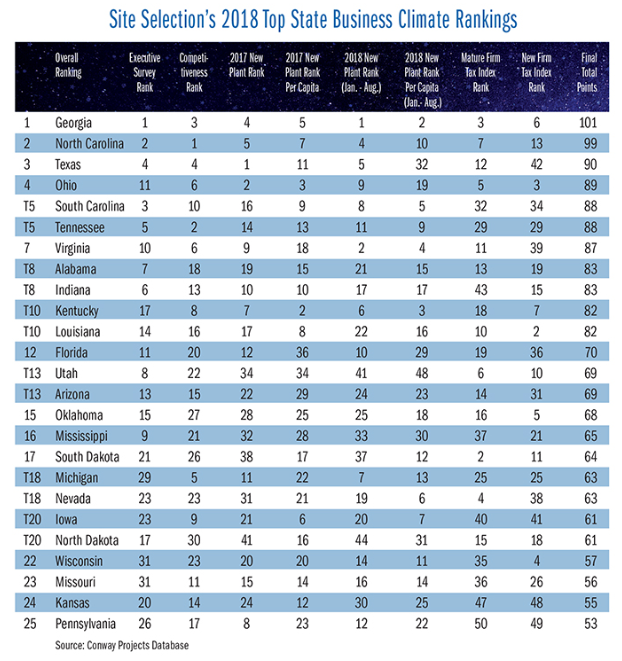
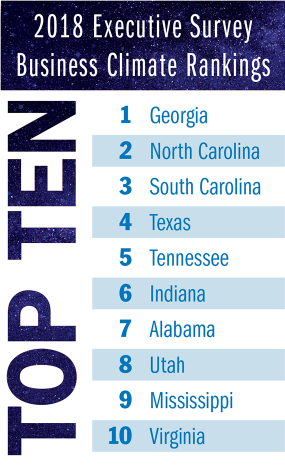
Talk about an opportunity zone. The term has a specific definition in the context of economic development, as the article beginning on page 80 explains. But the entire state of Georgia could be considered a zone of opportunity for companies seeking the nation's best business climate — year after year. A string of six consecutive first-place finishes means Georgia's performance in this annual exercise in any year since 2013 was not an anomaly. It's a pattern, and one that outgoing, term-limited Governor Nathan Deal helped set in motion.
Certain ingredients were already in the bowl when the governor came to office in 2011: the world's busiest airport with direct access to business destinations around the globe; bustling seaports; a diversified economy in the Atlanta area and statewide; top universities; and an already business-friendly environment thanks in part to his predecessor, two-term Gov. Sonny Perdue, now the U.S. Secretary of Agriculture.
What did Chef Deal add to the mix? Among other things, a commitment to fiscal soundness, economic predictability, smart investment in education and transportation and to championing the state's agriculture, film production and other key industries. He elaborated on these points in his last such interview with Site Selection in mid-October, not long after Hurricane Michael had ravaged a large swath of the state with devastating effects (losses north of $2.5 billion, conservatively) on its cotton, peanut, pecan, timber and other crops.
We covered that topic first.
"We have numerous people working to make sure that debris is removed from our roadways so utility crews can get in and restore power, especially to vulnerable institutions like hospitals," noted the governor. "Fortunately, we did not have flooding from this storm. But the high winds passed through the heart of our agricultural community. We are trying to get people back to normal as quickly as possible."
Trains and Boats and Planes
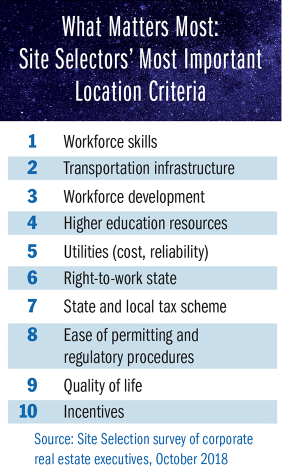
A big part of Georgia's business climate is transportation-based. Could Georgia do as well in this ranking without Hartsfield-Jackson International Airport with its fortress Delta Airlines hub and global passenger and cargo reach? No way. Countless businesses, large and small, are in Georgia thanks to that connectivity. Interstate highways in the Atlanta metro may be a daily thorn in commuters' sides, but investment in those, including reversible express routes that bypass local exits, is helping. By the way, it's not Atlanta's fault — nor its Interstate highways' — that the occasional livestock truck overturns during rush hour, sending cows, pigs or chickens onto the highway. That can happen anywhere.
"Infrastructure and transportation are essential ingredients to having a successful state for business," says Gov. Deal. "Our focus there has been to make sure we provide the necessary things government can and should do to make the business community grow and prosper."
 The Port of Savannah has record container volumes year after year and efforts to deepen the Savannah River and the port are ongoing. "The state has put in more than $300 million as its share of that cost, and the federal government is contributing its share, and we're hopeful that project will be complete by 2020 or 2021," the governor reports. "The Port of Brunswick is the second busiest auto port, and we have made some changes there to expand space for those vehicles. As we see an increase in automotive manufacturing and parts suppliers locating in Georgia, having access to the port for products coming in or going out is very important, and Brunswick is the key to that. The ports are responsible for almost $129 billion in economic impact, and exports have grown by 28.8 percent since I took office in 2011. Thousands of people are working across our state as a result of having robust ports."
In late October, Georgia Ports Authority (GPA) Executive Director Griff Lynch detailed Fiscal Year 2018 successes, including 630,000 units of cars, trucks and tractors handled through Georgia terminals.
"The Port of Brunswick achieved a solid performance across all cargo categories over the last fiscal year," Lynch said. "As GPA adds new terminal space, we will expand our service area in the Southeast and beyond."
During the event hosted by the Brunswick Golden Isles Chamber of Commerce, Lynch outlined a series of infrastructure projects that will increase capacity and provide new opportunities in Roll-on/Roll-off cargo handling. Over the next 12 months, GPA will add 60 dockside acres to the Ro/Ro operation. The new space will increase car storage by 8,250 spaces.
About that Traffic …
What does this mean for Georgia's Interstate highways, which next to rail are the chief arteries from the ports to points west and vice versa? The Interstates in and around Atlanta are so clogged at times the region loses points in the quality-of-life and logistics categories.
Atlanta traffic?
"It's a sign of growth," says the governor, returning the serve with more than a little topspin. But it's a fair point. More than 700,000 private-sector jobs have come into being and Georgia has jumped from the 10th most populous state to 8th most populous since he took office.
"With that comes traffic and congestion," he points out. "That's why the Transportation Act of 2015 was so important. It was the first time in 40 years that the state of Georgia had looked at how we finance infrastructure improvements. We're making progress on completing the 11 major projects that were part of that, most of which were Interstate-related. The reversible express lanes on I-75 south of Atlanta and now on the north side, too, are proving to be very successful in traffic congestion relief." Other measures include extending paid express lanes on I-85.
 "To fund these efforts, we're using public-private partnerships in a unique fashion, in which we engage the private contractor to carry part of the debt until the project is completed," the governor explains. "That is proving to be very successful. We believe we have saved a lot of money on the design-build concept we're using, which allows us to extend the HOT lanes on I-85 north considerably farther north than we had originally planned."
The role of inland ports in unclogging Interstates will soon become apparent, adds the governor. One has been operational in Cordele, in southern Georgia, for a number of years, but mainly for agricultural use. The Appalachian Regional Port (APR), in Murray County northwest of Atlanta, opened in August 2018. It is designed to provide logistics solutions for customers in a four-state region and remove an estimated 50,000 trucks and 15 million truck miles from local highways every year.
APR already is triggering development. The Foxfield Company, based in Bluffton, South Carolina, is developing a 750-acre (304-hectare) industrial park in Cartersville, on I-75, that will accommodate 7 million sq. ft. (650,300 sq. m.) of industrial space when completed. It's just 25 miles from the new port. Foxfield President Harry Kitchen, Jr., identifies several competitive advantages the ARP affords, including an efficient alternative to an all-truck dray to and from the deep-water Port of Savannah for target markets in Georgia, Alabama, Tennessee and Kentucky; lower transportation costs; and the ability to move hundreds of containers at once.
"While the needs of each industry and customer differ, the efficiencies gained through inland terminals means port customers would be wise to investigate the benefits of using the inland rail hubs," says Kitchen. "Lower costs for long-distance drays, convenient access to empty containers and the reliability of Georgia Ports Authority terminal operations make the inland ports important new supply chain assets."
The Foxfield Company mainly develops projects in Georgia, so we asked Kitchen for his take on Georgia's business climate, or its competitive advantage. It turns out it's about the state's economic development team.
"Major prospects are very savvy when it comes to assessing the positives and negatives of site selection," he relates. "Each state needs to identify the key drivers for each project and bring their best opportunities to the table. The site selection game is more about site elimination than site selection, and the best sites always rise to the top. Georgia does an excellent job in identifying the true needs of a prospect and putting the best team together to make the short list of candidate sites and close the deal."
“My intent was to put the roots down so deep that it would be very difficult for anybody to pull them out.”
— Governor Nathan Deal
Investment in the state's aviation infrastructure — its ability to staff the world's busiest airport and the state's aerospace-related companies — is ongoing. In October, Gov. Deal announced that the Technical College System of Georgia (TCSG) will establish an Aviation Academy to operate at Silver Comet Field at the Paulding Northwest Atlanta Airport. Chattahoochee Technical College will oversee operations and build a new facility to house the Aviation Academy, where students will train in aviation mechanics and maintenance.
"Here in the No. 1 state for business five times over [the sixth such win had not yet been announced], we are strategically building upon the economic assets that set us apart from other states and investing in academic resources to produce a highly skilled workforce," said Deal at the announcement. "With an investment of approximately $35 million, Chattahoochee Tech's Aviation Academy at Silver Comet Field is yet another example of a partnership between the state and local levels creating a resource that will benefit both the economy of the local community and that of our entire state."
Delta Air Lines, Gulfstream and Pratt & Whitney are among Georgia's leading aviation-related companies with major operations in the state. "To remain a suitable home for employers such as these and to connect Georgians with high-paying, quality jobs, we are investing in aviation mechanics and maintenance training through TCSG, which has a proven record of success in providing specialized training," says Deal.
Georgia ranks fourth in the nation for the number of individuals employed in the aviation field, and the job growth outlook for the industry exceeds national averages over the next 10 years. The programs will help fill an aerospace mechanic jobs deficit that in late 2018 stands at about 2,000 positions.
It's a Wrap
A final interview with Site Selection was an opportunity for the governor to take stock of progress made in areas discussed in previous interviews about Georgia's top national business climate. Following are highlights of that segment of the interview.
On education: "I asked the question back at the height of the Great Recession, when we were at 10.4 percent unemployment — we're now at 3.8 percent — do we have jobs in Georgia that are going unfilled because we don't have enough skilled people to take them? The answer was yes. We started the HOPE Career Grant Program, where 100 percent of tuition is paid for through our HOPE scholarship program. We started with four certificate or diploma areas and we're now up to 17, and I'm sure those will be added to in future sessions of the General Assembly."
On the film industry: "One of the 17 categories is in the film industry. We wanted permanency associated with the film industry, and the first sign of that came with the Pinewood Studios project in Fayette County, where they've built sound stages and have been very successful. They're filling them with movie companies that want to use them. We also wanted a workforce made up of Georgians, not crews coming into town from somewhere else. That's where the Georgia Film Academy came in for teaching those behind-the-camera skill sets." It's a collaborative effort of the University System of Georgia and Technical College System of Georgia supporting workforce needs of the film and digital entertainment industries.
"The next big area we're anticipating is on the creative writing side of things," says the governor. "We want resources for the bright minds who will figure out what the next television series will look like. We want them to be here in Georgia and to be Georgians if possible." The film industry has an economic impact well north of $9 billion. It employs more than 92,000, a third of which are direct Georgia jobs.
On workforce and the Quick Start training program: "It continues to be one of the great ingredients available to us, to be able to train prospects' workers to the skill sets they need without any cost to the company."
On fiscal soundness: "We have hopefully laid the foundations we needed to — we're now in excess of $2.5 billion dollars in our rainy day fund," says Gov. Deal. "I originally set a goal of $2 billion. It's one of those indicators of how financially solvent a state is — along with maintaining our AAA bond rating for 21 consecutive years. Very few states can make that claim."
On whether investors used to thinking of Georgia as consistently having the top business climate should view the state any differently as new leadership prepares to assume office in January 2019: "I don't think so. My intent was to put the roots down so deep that it would be very difficult for anybody to pull them out," says Deal. "I believe that has occurred. Members of the General Assembly, regardless of party affiliation, supported almost every one of these areas, because they are good for their constituents. When you put politics aside and realize your real purpose is to do the best you can for the future of the citizens that elected you and for their children and families, then I don't believe you will depart from the principles we have put in place."
Ranking Methodology
Fifty percent of the overall Business Climate Ranking is based on a survey of corporate site selectors who are asked to rank the states based on their recent experience of locating facilities in them. The other 50 percent is based on an index of seven criteria: performance in Site Selection’s annual Prosperity Cup ranking (formerly the Competitiveness Award); total Conway Projects Database-compliant facility locations and expansion projects in 2017; total projects in 2017 per capita; total 2018 projects year to date; total 2018 projects year to date per capita; state tax burdens on mature firms and on new firms according to this year’s Tax Foundation and KPMG Location Matters analysis.
Mark Arend
Editor in Chief of Site Selection magazine
Mark Arend has been editor in chief of Site Selection magazine since 2001. Prior to joining the editorial staff in 1997, he worked for 10 years in New York City at Wall Street Computer Review, ABA Banking Journal and Global Investment Technology. Mark graduated from the University of Hartford (Conn.) in 1985 and lives near Atlanta, Georgia.
November 26, 2018 | HR Cyber Security Webinar

According to the 2017 cybersecurity report by the Ponemon Institute, over half of all cyber attacks are now directed at small businesses. Are you prepared to prevent what happened to Equifax, Uber, Facebook and others from happening to you? Join Todd Slinker from Taylor English Decisions as he discusses why cyber security preparedness planning and enterprise risk management are essential to protecting your information, your clients’ information and the public at large. Additional topics discussed will include:
- Proper and consistent employee training is vital to help with the prevention of cyber attacks
- How to mitigate insider threats to corporate information assets
- Why many companies are adopting the Bring Your Own Device (“BYOD”) policy
- How to plan for an incident: response planning and preparation
- How cyber security can be used as a tool for growth
- And other similar topics
All attendees will receive one hour of SHRM/HRCI credit. Login information and reminders will be sent the week of the webinar.
Single Webinar Cost:
$40 Member
$55 Federation Member
$85 Non-Member

(READ MORE)
October 28, 2018 | 2018 Peach Regional Chamber of Commerce Awards Banquet

The Peach Regional Chamber of Commerce looks forward to honoring local businesses and individuals who really stood out during the year. Shane Gottwals will be the Special Guest Speaker for the event. His Peach County company, Gotwalls Books, won the 2018 Small Business Rock Star Award from the Georgia Department of Economic Development (GDEcD) and the Georgia Economic Developers Association (GEDA) in March of '18.
Awards will be given in the following categories:
- Business of the Year
- Small Business of the Year
- Cornerstone Award (Non-profit)
- Spirit of Community Award
The event will take place at the Byron Municiple Complex located at 401 Main Street, Byron, Georgia 31008
The cost is $30 per person. For more information on how to register or to purchase tickets, click here or call +1 (478) 825-3733
(READ MORE)
September 17, 2018 | Food Safety Breakthroughs Pioneered at FVSU Could Help Improve Health and Spur Economic Growth
Tuesday, September 18th, 2018
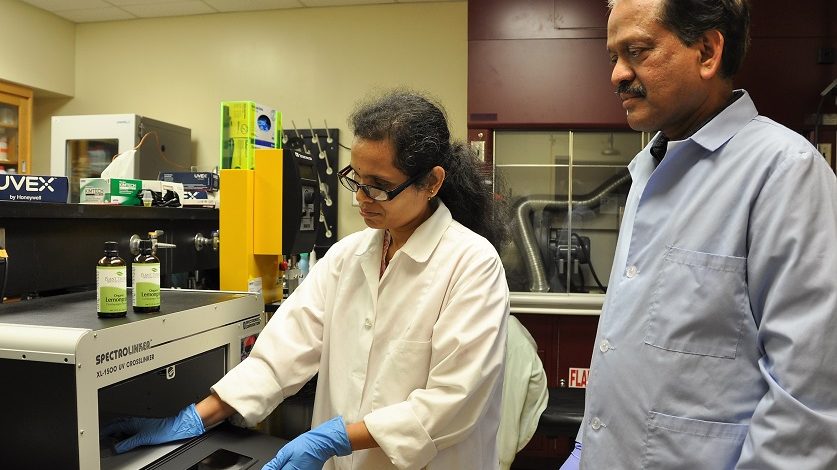
The IFTNext Newsletter recently featured the groundbreaking work of Dr. Ajit Mahapatra and other FVSU researchers, including graduate assistant Hema Degala, who are working to find innovative ways to decontaminate the meat of ruminants. Ruminants are animals like cattle, goats, sheep, and deer who digest plant-based food through a common, multi-staged process involving the chewing of cud. Dr. Mahapatra and his colleagues developed an inexpensive way to use lemongrass oil and ultraviolent light to destroy E.coli and other pathogens. Many of the processes used to destroy bacteria today use thermal and chlorine-based washing techniques that harm the quality of the meat. The FVSU researchers have pioneered a non-thermal approach.
“Increasing intensity of UV-C [ultra-violent light] and concentration of LG [lemongrass oil] significantly increased bacterial reduction on goat meat,” Mahapatra told IFTNext.
“Researched and written weekly by the editorial team of Food Technology magazine, the IFTNext Newsletter explores what are, arguably, the next big things in the science of food through original reporting of scientific breakthroughs, leading-edge technology, novel food components, and transdisciplinary R&D,” according to the publication.
The work of the researchers could have a direct impact on food consumption, especially in helping to elevate the production of goat meat, which has become more popular in the United States because of the health implications of a lower fat than beef, pork, or lamb, and, as noted by the newsletter, “a growing immigrant population accustomed to its consumption.” The U.S. Department of Agriculture has found that the number of goats slaughtered has doubled every decade for approximately the past 30 years. According to the Washington Post, goat meat, “has a third fewer calories than beef, a quarter fewer than chicken and much less fat: up to two-thirds less than a similar portion of pork and lamb; less than half as much as chicken.” From 2007-2015, global goat meat consumption increased annually by 2.4%, according to IndexBox Marketing and Consulting.
Dr. Mahapatra brings a global perspective to his work, understanding that farming and food production techniques developed at FVSU can have international implications when used by small farmers around the world. His career includes instruction and research at the University of Botswana and the University of Zambia. He earned his Ph.D. from the Hungarian Academy of Sciences in Budapest, a master’s degree from the Indian Institute of Technology in Kharagpur, and a bachelor’s degree from the Orissa University of Agriculture and Technology in Bhubaneswar, India. In addition to ruminant food safety, the certified food scientist has conducted research on stevia powder, beef and pork safety, ethanol production, information gaps in farm-to-table studies, rice flours, and food processing, among other areas.
Mahapatra recommends more research be conducted to determine if the effect of his approach on goat meat’s taste, color, and odor. If successful, he suggests, it could help improve the food’s acceptance among a broader swath of consumers. The technique can be particularly helpful to farmers with more limited resources, Mahapatra told IFTNext, “and will not only be useful in red meat, but can also be optimized and applied to seafood, poultry products, and fresh produce.”
Click here for link to original article.
September 12, 2018 | GEORGIA CHAMBER NAMED STATE CHAMBER OF THE YEAR

For Immediate Release
ATLANTA– September 13, 2018- The Council of State Chambers, (COSC) named the Georgia Chamber of Commerce the 2018 State Chamber of Year at its annual award ceremony held in New Orleans, Louisiana.
“I am proud to say for two years in-a-row, the Georgia Chamber has been named Chamber of the Year by two organizations,” said Georgia Chamber President & CEO, Chris Clark. “We are incredibly honored to receive this award and join a list of past recipients who have worked diligently to improve the quality of life and business climate statewide. Our success would not be possible without the hard work and dedication of our Board Members, executive leadership, partners, committees, and staff who have been instrumental in our efforts to strengthen our organization and represent the state of Georgia as its longest-serving business advocate. I would like to thank Governor Deal and members of our General Assembly for their servant leadership and commitment to ensuring Georgia remains the premiere location for businesses of all sizes.”
The State Chamber of the Year recognizes member-chambers who have demonstrated exceptional leadership and measurable success over the course of the last year, legislative session, or election cycle in areas of achievement including, Public Policy, Political Engagement, Membership and Development, Best Communications Program, and Membership Services. The selection of the State Chamber of the Year is a thoroughly vetted, three-stage process consisting of application review, finalists interview, and awards ceremony in which finalists and recipients are selected by a panel of three experienced chamber professionals.
The Georgia Chamber was recognized for the success of their current 8 for 18 initiative, which serves as a statewide prosperity agenda and nonpartisan resource that seeks to inform elected officials, political candidates, and voters on a series of policy recommendations and issue areas that are critical to Georgia’s economic future. The Chamber has successfully used this 8 for 18 platform to showcase their top priorities for 2018, statewide endorsements, and candidate assessments taken by candidates for Governor, Lieutenant Governor, and Secretary of State.
The annual State Chamber of the Year award highlights innovative initiatives and best practices that advance state chamber’s mission and efforts to provide deserved recognition to state chambers and their leaders who have distinguished themselves by providing exceptional services and results for their members and communities.
For more information on the Georgia Chambers 8 for 18 initiative, visit www.8for18.com.
MEDIA CONTACTS:
Neisha McGee
External Affairs Manager
404-223-2493
gmcgee@gachamber.com
Alex Coffey
Marketing Manager
404-223-2263
Christina Tuck
Communications Manager
404-223-2272
About the Georgia Chamber of Commerce
As the state’s largest business organization, the Georgia Chamber of Commerce represents investors in every county of our state with a diverse cross-section of over 500 industry sectors. Our membership includes both small storefronts and large corporations-no matter the size or type of business, we provide proactive policy, aggressive advocacy and meaningful investor services that impact your bottom line. Our number one mission is keeping, growing and creating jobs to make Georgia a better state for business. We work to ensure economic competitiveness, innovative solutions to challenges that state faces, and a commitment to high quality of life. The Georgia Chamber serves as a partner for local chambers across the state. While we have many of the same goals, the Georgia Chamber focuses on statewide issues that impact Georgia’s entire business community.
(READ MORE)August 15, 2018 | 2018 Employers In The Know

August 14, 2018 | Why Employees Do What They Do - Georgia Chamber Webinar

Human Performance: Understanding Why Employees Do What They
What is human performance? Simply put, human performance is a behavior plus results. Why is it important to your organization? Because understanding it can increase accuracy, completeness and efficiency. Join Gene Scott, Senior Safety & Health Specialist at Georgia Power, as he provides an overview of the five simple statements on the “Principles of Human Performance”
- People are fallible, and even the best people make mistakes
- Error-likely situations are predictable, manageable, and preventable
- Individual behavior is influenced by organizational processes andvalues
- People achieve high levels of performance because of the encouragement and reinforcement received from leaders, peers, and subordinates
- Events can be avoided through an understanding of the reasons mistakes occur in application of lessons learned from the past events (or errors)
Gene has been with Georgia Power for over 45 years, where he is now responsible for the safety and health of approximately 1,500 people across the state of Georgia including the Corporate Headquarters facility, by providing and coordinating training, safety briefings, safety presentations and ensuring compliance with OSHA regulations.
August 1, 2018 | Deal: Global commerce generates $5.56 billion in investments

Gov. Nathan Deal today announced that the Georgia Department of Economic Development’s (GDEcD) Global Commerce Division helped create a total of 27,373 new jobs during FY 18, generating $5.56 billion in investments. This growth is the result of a record-breaking 419 expansion or relocation projects throughout the state.
“Industry leaders and companies from around the world continue to choose Georgia thanks to the world-class, business-friendly environment we have built over the last eight years,” said Deal. “Georgia’s unparalleled resources, including our highly skilled workforce and our physical and digital infrastructure, continue to attract international companies that are planning to expand or relocate. These numbers reflect Georgia’s appeal to global job creators and translate to real economic growth in our communities and new job opportunities for families across the state. Nearly 80 percent of these projects brought investments to communities outside of the metro Atlanta area, demonstrating the depth of talent, investment and connectivity available in every corner of the state.
“With the support of the General Assembly and local officials, Georgia has established a worldwide reputation as a reliable and innovative place for businesses of all sizes to plan for future growth. I commend Commissioner Pat Wilson for his leadership, as well as the dedicated GDEcD team that works to keep Georgia on the minds of business executives around the world. As we head further into this century of promise and work to maintain Georgia’s position of leadership on the international stage, we are creating opportunities today and for generations to come. While we have cemented our reputation as the No. 1 state in which to do business, we are also making Georgia the best place to live, work and raise a family.”
State snapshot for FY 18:
- 419 projects generated $5.56 billion in investments and created 27,373 jobs.
- Nearly 80 percent of projects were located outside of metro Atlanta counties, resulting in the creation of 14,447 jobs and $4.6 billion in investments.
- Businesses already located in Georgia created 13,864 jobs and generated $2.84 billion in investments.
- Companies new to the state created 13,499 jobs and generated $2.72 billion in investments.
- There was job growth of 153 percent in the software and technology sectors, and 83 percent for data centers.
- 89 international projects (Foreign Direct Investment) created more than 6,800 jobs and generated more than $1.9 billion in investments.
- European companies included 49 locations, created 3,831 jobs and generated $837 million in investments. Companies from the United Kingdom, France and Germany led European companies in job creation.
- Companies based in Asian countries included 24 locations, created 1,822 jobs and generated $489 million in investments. Korean and Japanese companies provided the largest investments among Asian companies.
- GDEcD’s Entrepreneur and Small Business team served 586 businesses, 60 percent of which are startup companies.
“FY 18 was an incredible year for GDEcD’s Global Commerce Division, and I am proud of their hard work and dedication to Georgia,” said GDEcD Commissioner Pat Wilson. “Creating this kind of impact in the state is not a one-person job – we work closely with our local economic development partners, utility partners, sister state agencies, educational institutions and beyond to provide our new projects and existing industries access to competitive advantages and strategic assets. These results are a win for all of us.”
GDEcD’s Global Commerce Division is responsible for helping companies from around the world locate or expand in Georgia. The division partners with state agencies and local communities throughout the state to facilitate job growth and investment.
“We enjoyed an impressive FY 18, and I cannot thank my Global Commerce team across the state and around the world enough for their hard work,” said Tom Croteau, GDEcD deputy commissioner of Global Commerce. “Georgia is the ideal place for all companies to succeed. We are excited to build on this momentum in FY 19 and eager for the economic development opportunities that are ahead of us.”
 FY 2018 Global Commerce Project Announcements (includes 2 in Peach County)
July 30, 2018 | Critical Issues Forum 2018

July 30, 2018 | The Future of Cybersecurity is in Georgia

Georgia’s new $100 million Cyber Center is the single largest investment in a cybersecurity facility by a state government to date. This virtual environment inspires public-private collaboration across many sectors. Here in Georgia, we believe in strengthening cyber defenses and combatting the complexities of cyber-attacks through a smart, and highly skilled workforce. Learn more about our growing cybersecurity industry here.
(READ MORE)